
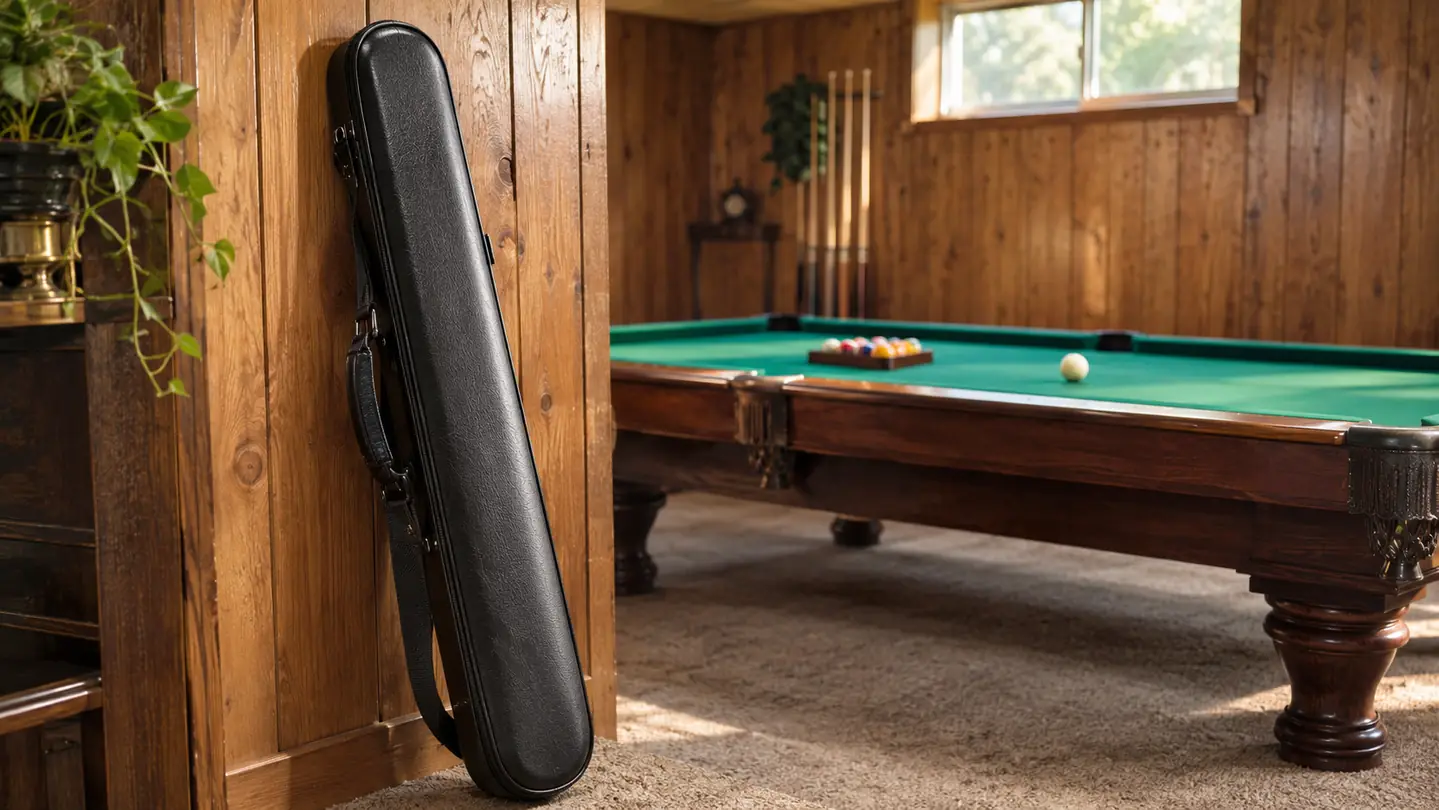
I kept my cues leaning in the corner of the basement for years, like a couple of rake handles, and I told myself it was fine. Then one February I pulled my playing cue out, rolled it across the felt, and watched the tip lift off the cloth by a quarter inch. A warp. Not a bad one, but enough that I started steering the cue instead of stroking it, and that is the beginning of a long slide. The BY SPORTS 2x2 hard cue case is what I should have bought years earlier, not because it is a fancy case, but because a cue that lives in a hard tube stops collecting the small daily damage that comes from living in a corner of a room.
Here is the honest version, and it is the version I would want if I were reading this instead of writing it. The BY SPORTS case does the one job that actually matters: it keeps two 58 inch two-piece cues apart from each other inside a hard shell, with the butts and the shafts in their own compartments. It is not a piece of luggage. The shoulder strap is adjustable and it is fine. The pockets are smaller than the listing photos make them look. The zipper is the part that will decide whether you still like this thing in three years. I have used it long enough to have opinions about all of it, so here they are, in the order they occurred to me.
The Quick Verdict
A hard shell that does the one job that matters: two 58 inch two-piece cues, held apart, protected from the corner-of-the-basement damage that quietly bends shafts. The pockets are the compromise.
Amazon Check Today's Price →Stop letting the corner of the basement bend your shaft
Hard shell, four compartments, adjustable shoulder strap, holds two 58 inch two-piece cues. Check today's price on Amazon and read the pocket dimensions before you commit.
Amazon Check Today's Price on Amazon →How I've Used It
I shoot Tuesday nights in an 8-ball league at a pool hall about fifteen minutes from the house, and I practice on an 8-foot slate table in the basement most weekends, usually with my son Mike or whichever teammate wants to come over and donate a few dollars. That means the case travels once a week and sits on a shelf the rest of the time. It has been rained on walking from the car to the door. It has ridden in the trunk on a 90 degree day and in the trunk on a 25 degree night. It has been dropped once, off the top of a pile of bags onto a concrete floor, which was not part of any plan I had.
That is not laboratory testing. That is just what happens to a case over a couple of seasons when nobody is being careful with it. But it answers the question people actually have, which is whether the thing holds up when life happens to it. For me, yes. The shell picked up a scuff on one end where it hit the concrete, and nothing cracked or caved in. The cues inside were straight. I opened it up braced for a bent joint and found two straight cues and a lot of wasted worry.
Day to day it is simple. Two butts in one side, two shafts in the other, zipper closed, strap over the shoulder. The case is 34 inches long and 4.67 inches wide, so it rides at an angle across your back instead of hanging straight, and on a crowded league night that means you turn sideways a little more often than you would like. It fits lengthwise in the trunk of a sedan if you angle it. It does not fit in a gym bag and I would not try.
The carry option is the adjustable shoulder strap, and how you set it changes the whole experience. Let it out long and the case hangs at your hip and swings like a pendulum with every step. Pull it in short and the case tucks up under your arm and stays put, which is how I carry it now. On a league night when you have a drink in one hand and a score sheet in the other, that difference matters more than I expected it to.
A 58 inch two-piece cue breaks down into two pieces of about 29 inches each. The case is 34 inches long, so each piece has a few inches of slack to sit in. That slack is worth understanding. It means the cues are not jammed end to end with no room for the tip to breathe, and it also means a slightly longer cue would still go, though I would not push that without measuring first.
What Nobody Tells You About a Hard Case
Nobody tells you that a hard case behaves differently on your body than the soft bag you are replacing. The BY SPORTS case is a rigid tube with a shell, and it does not collapse against your side the way fabric does. Walking into the hall, that is a mild annoyance. Walking six blocks to a hall in the rain, it is a real consideration, because a rigid case holds its shape and your arm gets tired of holding it away from your leg. None of that is a defect. It is just the trade you make for a shell that does not fold when something heavy lands on it.
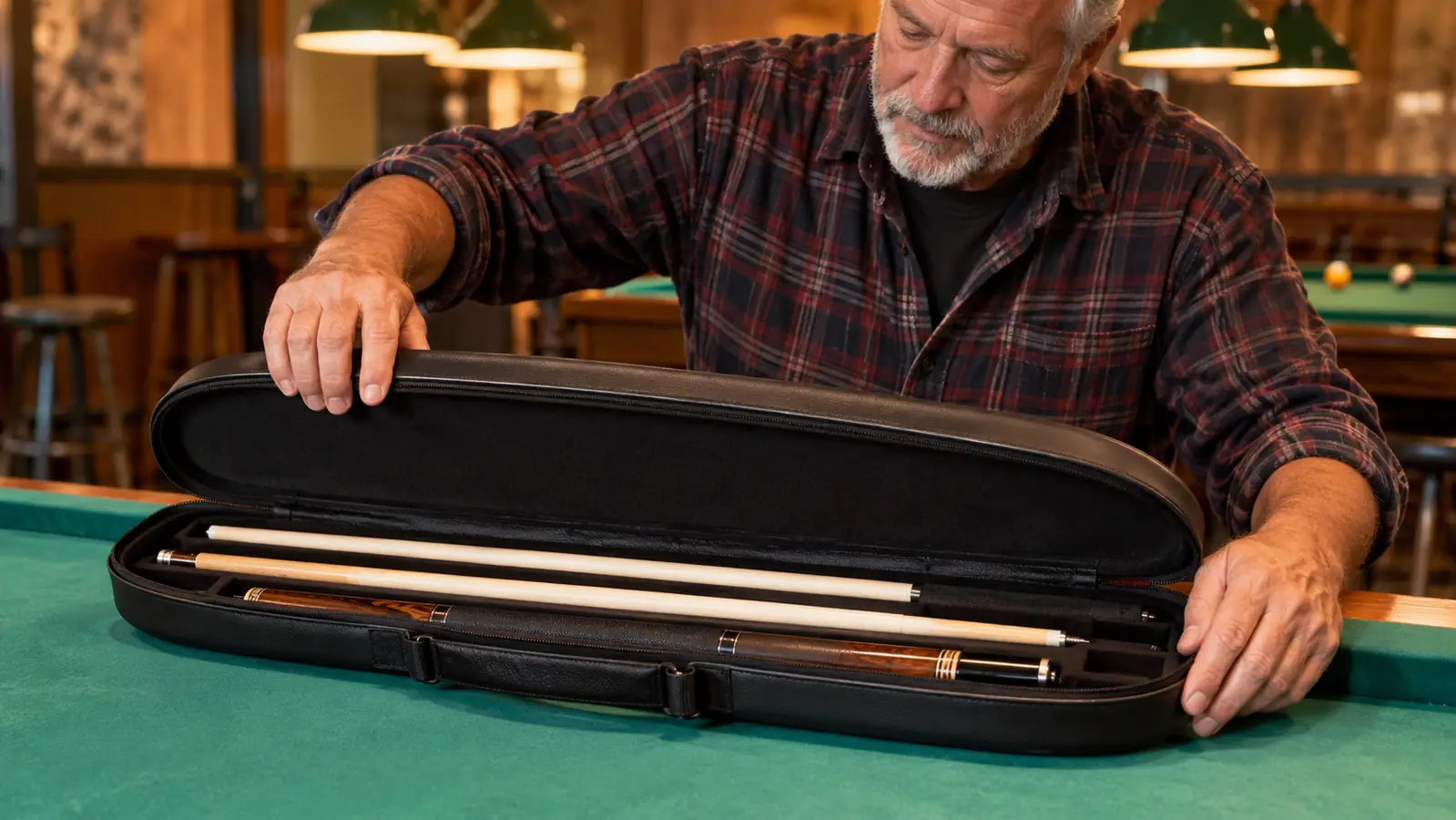
Nobody tells you that the inside of a hard case is where the real design work happens, and that the difference between a good one and a cheap one is separation. You want the butt of one cue nowhere near the shaft of another, because the finish on a butt and the finish on a shaft are not equally tough, and a joint pin riding against a shaft in a moving car will leave a mark every time. This case has four compartments and holds two butts and two shafts, and in practice that means every piece has its own slot. Nothing in my case has ever come out with a new mark on it that it did not go in with.
The other thing nobody tells you is the big one. A hard case does not protect against the thing that warps cues most, which is heat and moisture over long stretches, not impact. The listing calls the covering hard PU artificial leather and says it is effectively waterproof, and I believe the shell keeps rain off. But a closed tube in a hot trunk in July is a closed tube in a hot trunk in July. If you leave your cues in the car all summer, no case on the market is going to save you. Carry them inside. That advice is free and it is worth more than the case cost.
And nobody tells you that a case will not make you a better player. It will not add a ball to your run. What it does is stop you from losing ground you already earned, by keeping the shaft straight and the tip protected so the cue you practiced with in March is the same cue you are shooting with in October. Practice is what makes you better. The case just refuses to get in the way, and after a couple of warped shafts, that is not a small thing.
Two seasons of league nights and one drop onto concrete, and the only mark on the case is a scuff on one end. The cues inside were straight.
The Zipper Does More Work Than the Shell
If I had to name the part of this case that decides whether you are still using it in five years, it is not the shell. It is the zipper. The shell is hard and wrapped in synthetic leather, and hard things generally stay hard. Zippers are the moving part, and moving parts are what fail on anything. The BY SPORTS case uses a zippered closure running around the perimeter, and after a couple of seasons of opening it once a week it still tracks clean. No skipped teeth, no spot where the pull has to be jiggled to get it moving.
I have had exactly one problem and it was my fault. I zipped the case shut with a shaft sitting slightly proud of its slot and caught the edge of the shaft in the track. Nothing broke. It took two minutes with the pull to walk it back out, and I have been more careful about seating the shafts since. The lesson is not about this case. It is about any zippered case: push the cue all the way down before you close it. Cheap habit, saves grief.
One clarification, because I have seen people buy the wrong thing expecting the wrong feature. The closure is a zipper. There is no latch, no lock, no combination. If you are looking for something that keeps a determined teenager out of your cues, this is not that and it never claimed to be. It keeps the cues in and the dust out. That is the entire security model.
What Two Seasons Actually Did to It
Cosmetically, the case looks used, and I would be lying if I said otherwise. There is a scuff on one end from the concrete drop. The synthetic leather has gone a little dull where my hand lands when I pick it up, which is the same place on any case you own long enough. Nothing is peeling. No seam has opened. The strap anchor points have not stretched or frayed, and those are the spots I expected to go first because they take the whole load every time you pick the thing up.
Functionally, nothing has changed. The zipper pulls the same as it did the first week. The compartments still hold their shape, so the cues still seat all the way down without me fighting them. The pocket flaps still close. If I handed it to you and did not tell you how old it was, you would guess a season, maybe two, and you would be right. That is about the best thing I can say about a piece of gear at this level: it stopped being interesting, and interesting is what you do not want from a case.
The Pockets Are Smaller Than the Pictures Suggest
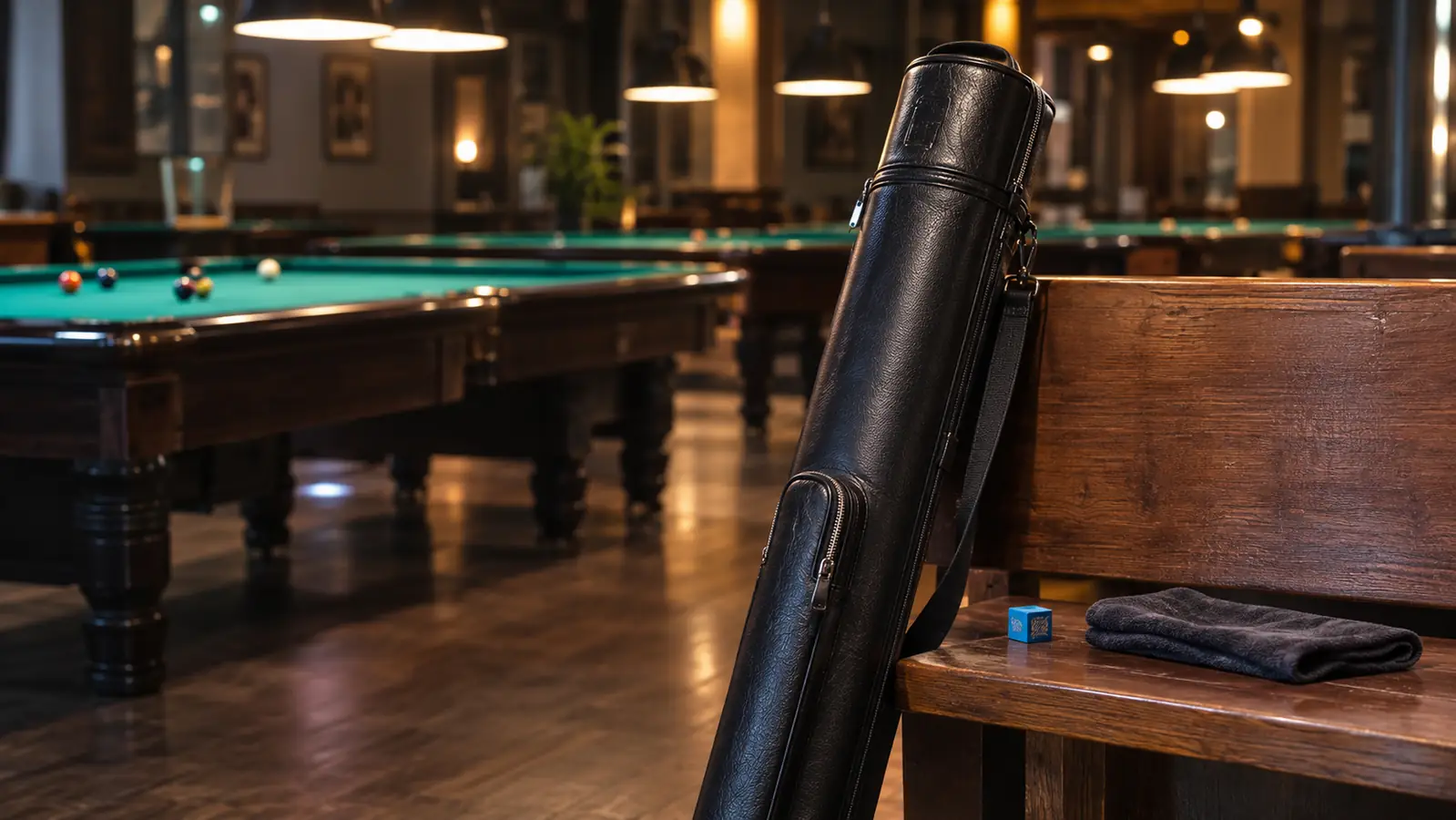
The listing gives pocket dimensions and I should have read them more carefully before I ordered. The small pocket is 6 inches by 3 inches by about an inch and a third. The large pocket is 16 inches by 3 inches by about an inch and a third. Sixteen inches sounds generous until you picture it. A foot and a third of length with an inch and a third of depth is a slot, not a pouch. A tip tool fits. A small shaper fits. A full sheet of sandpaper does not, unless you fold it, and then it does not fit well.
What lives in the large pocket for me: a spare tip scuffer, a cube of chalk, a folded microfiber cloth, and my league card. What does not fit: a jump cue butt, a full box of chalk, or a cue ball. I have watched a man try to put a cue ball in a case pocket, so I know that question comes up. If you carry a small kit, this is fine. If you carry a rolling accessory collection, it is not, and no amount of hoping will change the depth of a pocket.
What I Liked
- Four compartments keep two butts and two shafts from ever touching each other
- Hard shell took a drop onto concrete without cracking or caving in
- Zipper still tracks clean after a couple of seasons of weekly use
- Adjustable shoulder strap tucks under the arm when you shorten it
- Fits two 58 inch two-piece cues with a few inches of slack to spare
Where It Falls Short
- Large pocket measures 16 by 3 by about an inch and a third, so accessory room is limited
- A 34 inch rigid shell swings at your hip when the strap is let out long
- Zippered closure, so there is nothing to lock it with
- Holds two cues only, which means a second case if you start collecting
- Synthetic leather goes dull where your hand lands, purely cosmetic
What I Would Change
If I were designing the next version of this case, I would make the large pocket deeper before I changed anything else. An inch and a third of depth is the one number in this whole review that I would push back on. Give me two inches and a full box of chalk goes in, a towel goes in, and the case stops being a cue holder that also carries a cube of chalk. Everything else about the case I would leave alone, because everything else has held up under ordinary use, and ordinary use is the only test that matters to a league player.
Who This Is For
This case makes sense for a league player who owns two cues, or one cue and a backup, and who is tired of finding fresh damage on equipment that lives in a corner or a car. It fits if you play once or twice a week, you keep your cues for years, and you would rather spend once on a hard shell than replace a shaft. It also makes sense for the guy who just bought his first decent production cue and is still carrying it around in the cardboard box it shipped in. That box is not doing anything for you.
Who Should Skip It
Skip it if you carry one cue and nothing else, because a 2x2 hard case is more case than you need and you will notice the size every single week. Skip it if you are a road player traveling with four or six cues, because this holds two and you will end up buying a second case anyway. Skip it if you want a case that swallows a cue ball, a jump butt, a full accessory kit and a towel, because the pockets are 3 inches deep and an inch and a third wide and they will not. And skip it if you are hoping a case will fix a cue that has already warped. It will not. It stops new damage. It does not undo old damage, no matter how much you want it to.
If you are tired of finding fresh marks on your shaft, this is the fix
Holds two 58 inch two-piece cues in four separate compartments, in a hard shell, on an adjustable shoulder strap. Read the pocket dimensions first and you will know exactly what you are getting.
Amazon Check Today's Price on Amazon →