
A pool cue is two straight pieces of wood that would like to stay straight, and almost everything about how we carry them works against that. I watched a man lean his cue against the leg of a table at the hall, turn around for his beer, and hear it come down flat on the floor. The joint was fine. The shaft had a ding in it he could feel on every stroke for the rest of the night, and he shot badly for a month after that, not because he forgot how to play.
That is the whole argument for a hard case. Not theft, not looks, not the strap. Straightness. A cue spends most of its life in the trunk of a car, the back seat, a closet, or a corner of the basement where the damp gets in, and wood moves in all of those places. You almost never notice it happening. You notice it later, as a shot that keeps finishing a half inch short on the same side, and you blame your stroke. The BY SPORTS 2x2 hard cue case is a rigid shell with four compartments that carries two complete two-piece cues, and after a couple of seasons of Tuesday league nights and weekend practice on my own table, I can tell you exactly what it does and what it does not do.
Your cue is only as straight as the last place you leaned it
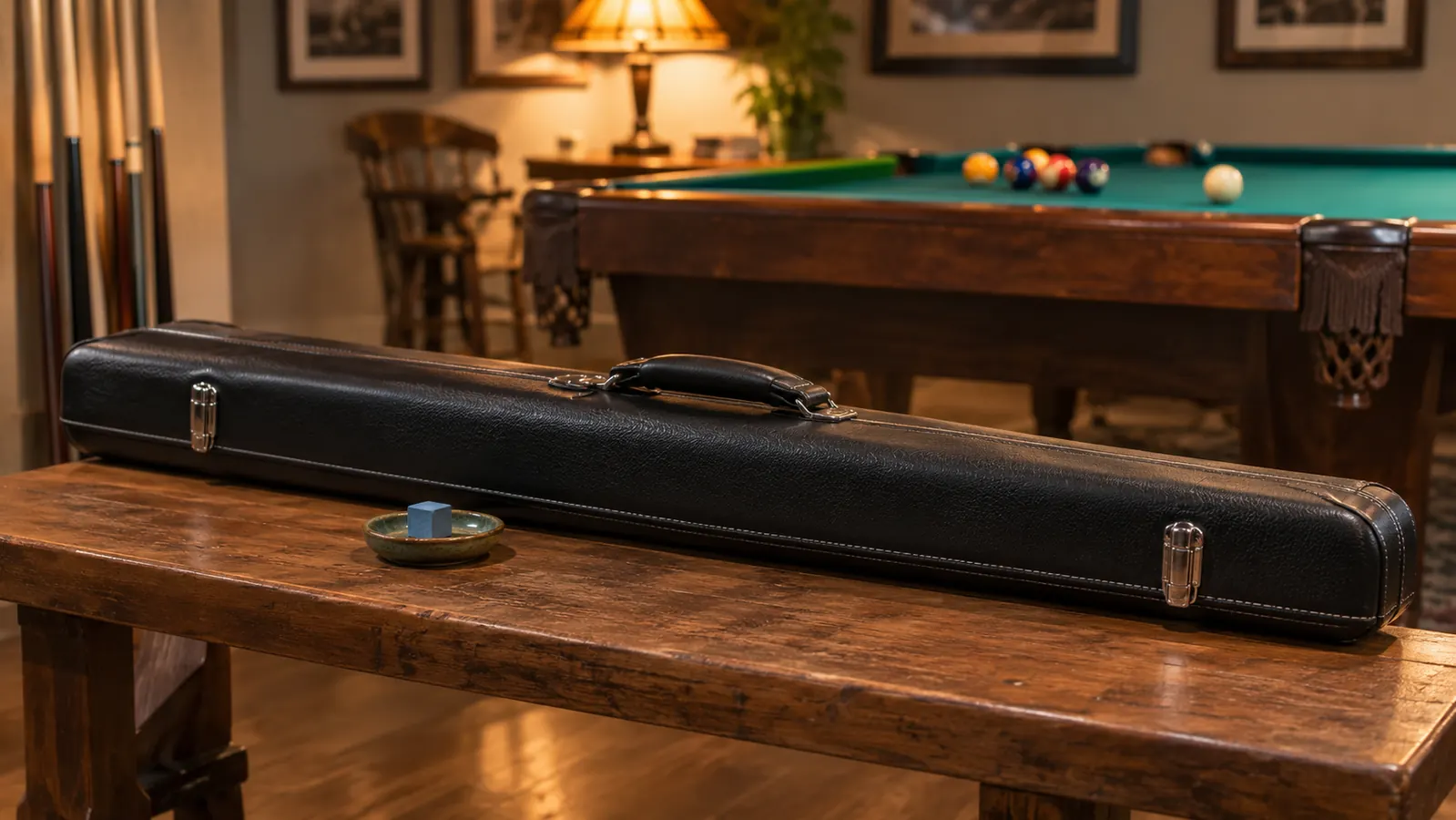
The BY SPORTS 2x2 hard case is a 34 inch rigid shell with four compartments for two butts and two shafts, an adjustable shoulder strap, and two zippered pockets. It carries a pair of 58 inch two-piece cues and keeps them off the floor.
Amazon Check Today's Price on Amazon →What a Hard Case Actually Does
A hard shell does three unglamorous things. It keeps the cue from getting knocked, it keeps moisture off the wood, and it holds the cue in one fixed shape while it sits. The shell on the BY SPORTS case is hard PU leather over a rigid body, so it does not fold in on the cue when the trunk gets full of groceries. It measures 34 inches long and 4.67 inches across. That is a long tube with one job.
The thing a hard case does that a soft bag cannot is keep a shape. A soft bag lets the cue take the shape of whatever is next to it, which is fine for the ten minute ride to the hall and not fine for a weekend in a hot trunk. The other thing a hard case does is keep the cue out of the air. The PU surface sheds a spill and wipes dry, so a wet night in a parking lot does not soak into fabric and sit against the wood until morning.
What a hard case does not do is straighten a cue that is already bent, and it will not make you shoot better. I want to be clear about that, because the marketing on every case ever made suggests otherwise. A case protects an investment you already made. The stroke is still yours.
Before You Start: What the Case Has to Fit
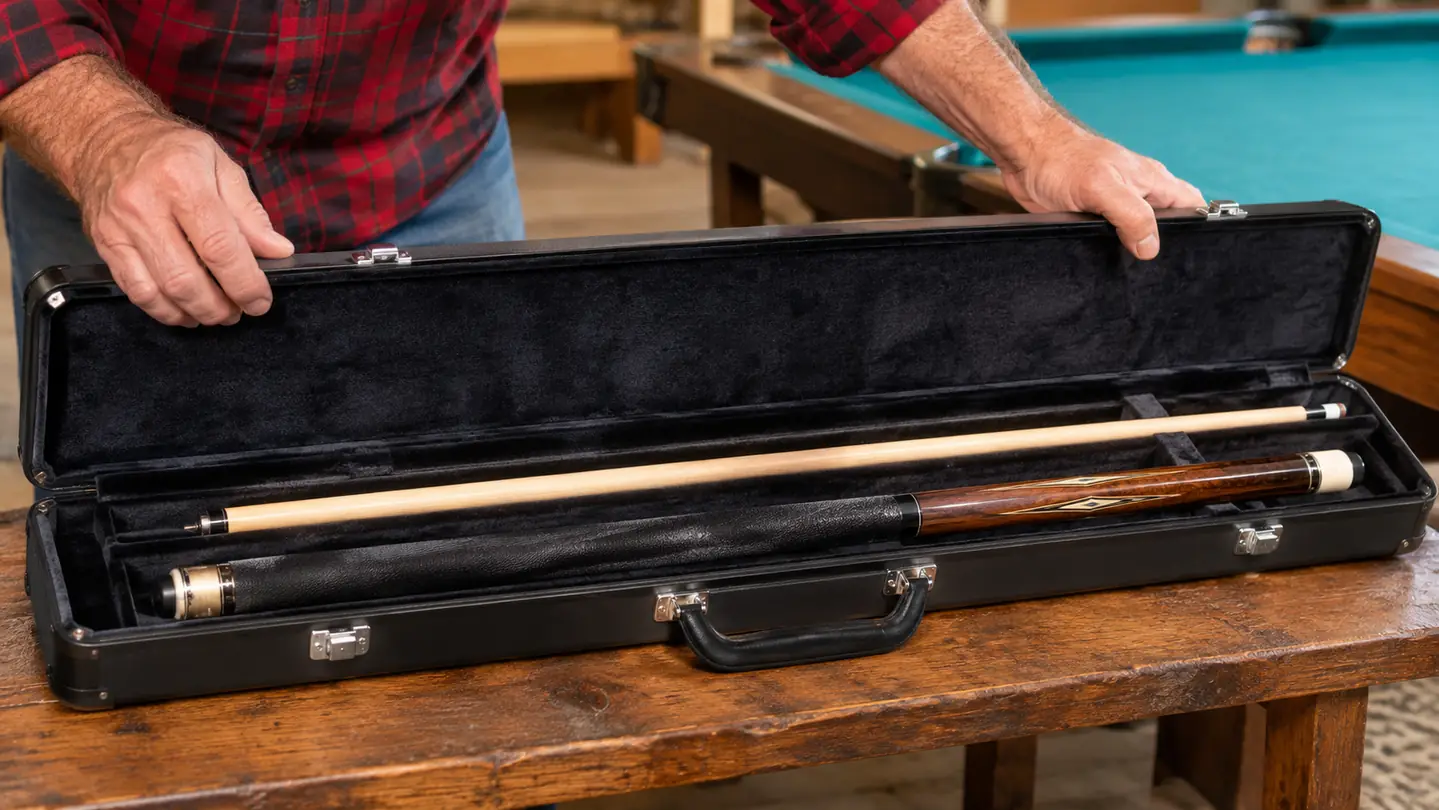
A two-piece cue breaks down at the joint, so a 58 inch cue gives you two halves of roughly 29 inches. The case is 34 inches long, which leaves about five inches of air at the bottom when a cue is seated. That slack is not a defect. It is what lets the cue slide in without being forced and what keeps the end of the shaft from taking the whole load.
This particular case is built for two butts and two shafts, so it is a two cue case. If you own one cue, you will have two empty compartments, and that is fine. If you own a cue with an extension, an extra long shaft, or a one piece house cue you are fond of, measure it first, because a 34 inch case is a 34 inch case and there is no negotiating with it.
Step 1: Unzip It and Lay It Flat on Something Clean
Open the case all the way and lay it flat on a bench, a table, or the carpet. Not on a chair, not balanced on the rail of the table, not propped on your knee. The zipper runs the full length of the case, so the top comes away and you can see every compartment at once. You want the case level and open so that nothing has to be forced into place.
Before anything goes in, wipe the inside out with a dry rag and look for grit. Chalk dust, sand from a parking lot, a little piece of gravel off the floor at the hall. All of it gets in there and all of it is abrasive against a shaft that slides past it twice a week. I do this about once a month whether the case looks dirty or not, and it takes less time than racking a single game.
Then check the case itself. Set it on the table, stand back, and sight down its length. A hard case should be straight, and if it has been sat on, stepped on, or left under something heavy in the garage, it will tell you. A case with a bow in it is not protecting anything, it is bending the cue a little every time you close it.
Step 2: Keep Each Shaft With Its Own Butt
You are carrying two cues, which means four pieces that all look alike in a dim pool hall at nine at night. Keep the parts of cue one on one half of the case and the parts of cue two on the other half. That way you never stand at the table with a butt in one hand and a shaft that belongs to the other cue in the other, wondering why it feels off.
It also matters because the joint is a fitted pair. The pin, the collar, and the threads have been wearing against each other since the cue was new, and they wear in a pattern. Swap shafts between two butts every week and both joints wear a little faster, and neither one feels quite the way it did. It is a small thing that shows up over years.
I mark mine with a strip of tape on the inside of the compartment, one for the playing cue and one for the break cue. Fifteen seconds of work the first time, and after that you never think about it again. If you only own one cue, this step is easy. Butt in one compartment, shaft in the one beside it, and the other two stay empty for the night somebody hands you a house cue to carry back to the rack.
Step 3: Slide Them In Joint End First
The joint end goes down. That is the end with the collar and the threads, and it is the toughest part of the cue. The tip and ferrule are the fragile end, and the last thing you want is the weight of a shaft resting on a tip for a two hour drive. Joint end down, tip up, every time, on both the butt and the shaft.
Because the case is 34 inches and the halves are about 29, there is roughly five inches of room at the bottom. The cue goes in without a fight and it does not bottom out hard. Slide it until it stops and leave it alone. If a piece will not go in, the case is not the problem. Either there is something in the compartment, or you are trying to put a third shaft into a case that holds two.
Do not stack, do not jam, and do not force the zipper at the end. If the zipper fights you, something is not seated. Open it back up and find out what, because a zipper that gets forced once starts catching every time after that, and a case that will not close in a hurry at the end of league night is a case you stop using.
The case is 34 inches long and the halves of a 58 inch cue are about 29. That five inches of air is why the cue goes in easy and comes out straight.
Step 4: Use the Pockets for the Small Stuff
There are two zippered pockets on the outside. The small one runs about 6 by 3 by an inch and a third, and the large one about 16 by 3 by an inch and a third. Small pocket gets chalk, a tip pick, a shaper, a glove, and a couple of dollars for the table. Large pocket gets a microfiber cloth, a spare tip, joint protectors, and the league schedule you keep forgetting to look at.
What does not go in either pocket is anything hard and loose that will rub against something. Keys, a multitool, a screwdriver, a metal file. I have seen a case with a set of keys in the outside pocket and a shaft with a line down it you could catch a fingernail in. The keys won. The case did nothing wrong and the pocket did exactly what pockets do, and the shaft paid for it.
Chalk deserves its own mention. It is abrasive, it gets on everything, and it will coat the inside of a pocket in a fine dust that finds its way into the compartments. I keep mine in a small zip bag inside the pocket. It costs nothing and it keeps the inside of the case from looking like the floor of the hall.
Step 5: Carry It on the Strap and Put It Down Flat
The strap is adjustable, so set it once and leave it. Wear it across your chest with the case behind your hip rather than hanging off one shoulder, especially on a wet night when the parking lot is slick and you are carrying a drink. A 34 inch case takes up a lot of room, and nobody at the hall is watching where they turn with a tray of wings.
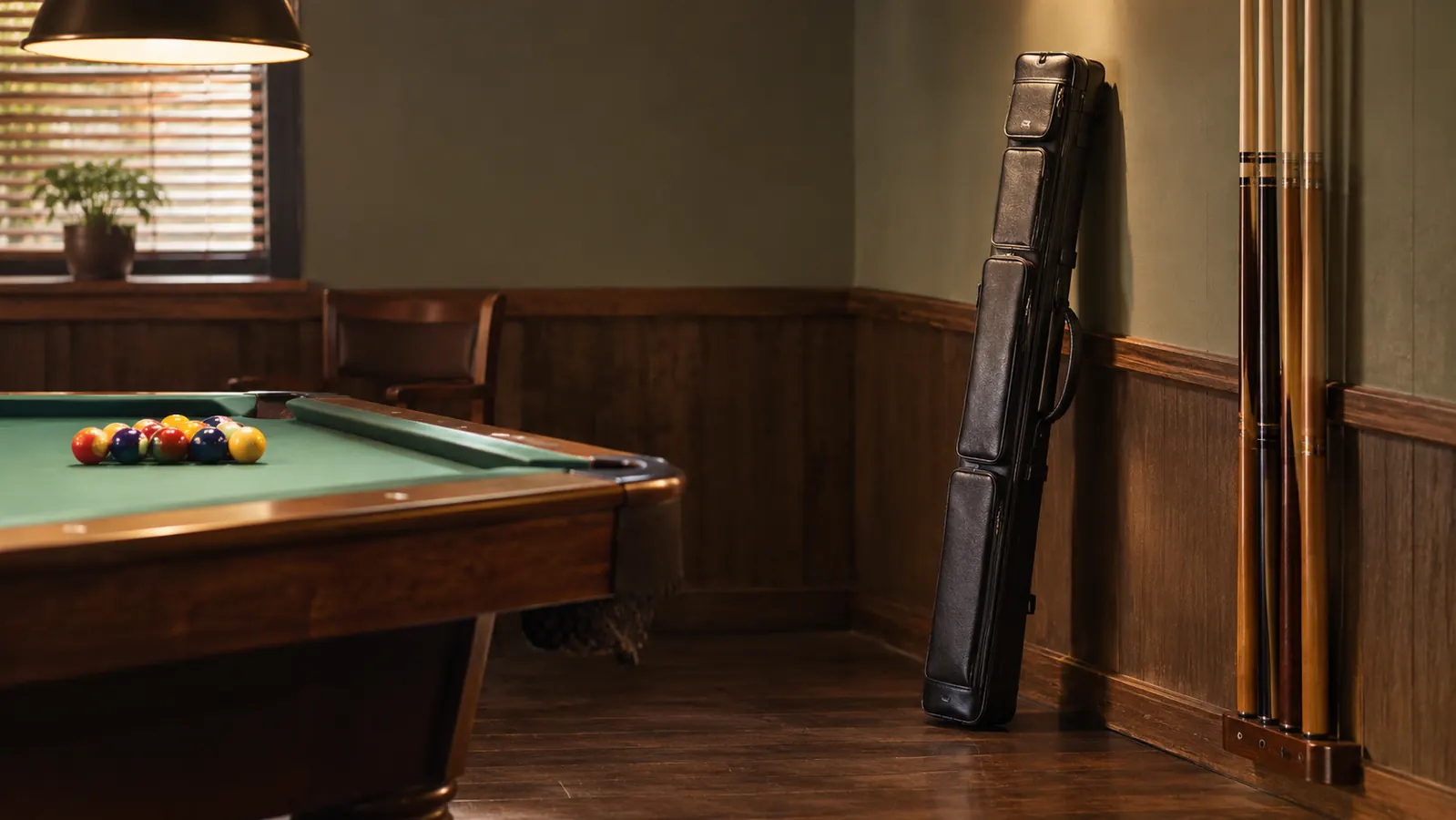
Where you put it down matters more than how you carry it. Lay it flat on the floor, or stand it upright in a corner where nobody walks. Never lean it against a wall at an angle. Never hook it over the back of a chair. Never leave it on the rail of the table, where a hard break will shake it off onto the floor. Half the dings I have seen on otherwise well kept cues came from a case standing on its own that got knocked over.
In the car, lay it flat on the floor behind the front seat. Not on the rear shelf, not propped against a door, and not in the trunk of a hot car in July. Heat is harder on a cue than a knock. A hard case does not make a trunk cool, it just means the cue takes the heat while sitting perfectly straight instead of bowed against a bag of groceries.
What Else Helps
Joint protectors are worth ten minutes of your life. They screw onto the pin and the collar, they cost less than a box of chalk, and they keep dust and grit out of the threads so the cue goes together smooth every time. If you use them, put them on before the cue goes into the case, not after, or you will be digging them out of the pocket with cold fingers at the end of the night.
Wipe the shaft before it goes in. Whatever is on the shaft at the end of the night ends up in the bottom of the compartment and stays there until you clean it. A dry cloth and ten seconds is the whole routine, and it is the difference between a shaft that feels slick in a year and one that feels like a chalkboard.
A hard case is not a storage unit. If you stop playing for the winter, take the cue out, wipe it down, and stand it upright in a dry corner of the house rather than leaving it in a case in a cold basement. Air moves around a cue that is standing in the open. A case is for transport and for the weeks between league nights, not for six months in a garage.
If the case gets wet, open it and let it dry before the cue goes back in. Same for a night out in the rain. The PU surface sheds water, but the zipper and the seams will hold a little, and a closed case with a damp interior is a small greenhouse for wood.
And if you are deciding between a hard case and a soft bag, it comes down to where the cue lives. A soft bag is lighter on the walk from the car to the hall and takes less room in a crowded corner. A hard case is what you want for the trunk, the closet, the flight, and the stretch of weeks when you are not playing much. I keep both in the basement. The hard case does the long trips and the storage. The soft bag does the ride to league when I am running late.
The Mistake I Still See Every Tuesday
Almost every cue I see come out of a case at league night comes out of a soft bag, and about half of those players lean the bag against the wall behind the table for the next three hours. The bag offers no shape, the wall offers no support, and by the time the cue goes back in the car it has spent the evening learning the contour of a cinder block. Then they wonder why the cue rolls a little on the table.
The other one is the guy who buys a good hard case and then stores the cue in the corner of the basement leaning against the water heater. The case protects the cue on the trip. It protects nothing while the cue sits outside it. Both habits are free to fix, and neither one has anything to do with how much you spent.
The gear stops getting in the way. That is all it does. A straight cue in a solid case in the back of the car gives you one less excuse on Tuesday night, and after twenty years of league play I can tell you that one less excuse is worth more than any gadget in the bag.
Two cues, four compartments, and a case that keeps its shape in the trunk
The BY SPORTS 2x2 hard cue case carries two complete two-piece cues in a rigid PU leather shell, with an adjustable shoulder strap and two zippered pockets for chalk and tools. Rated 4.6 stars across 2,083 reviews. If you plan to keep a cue for years, give it somewhere to live.
Amazon Check Today's Price on Amazon →