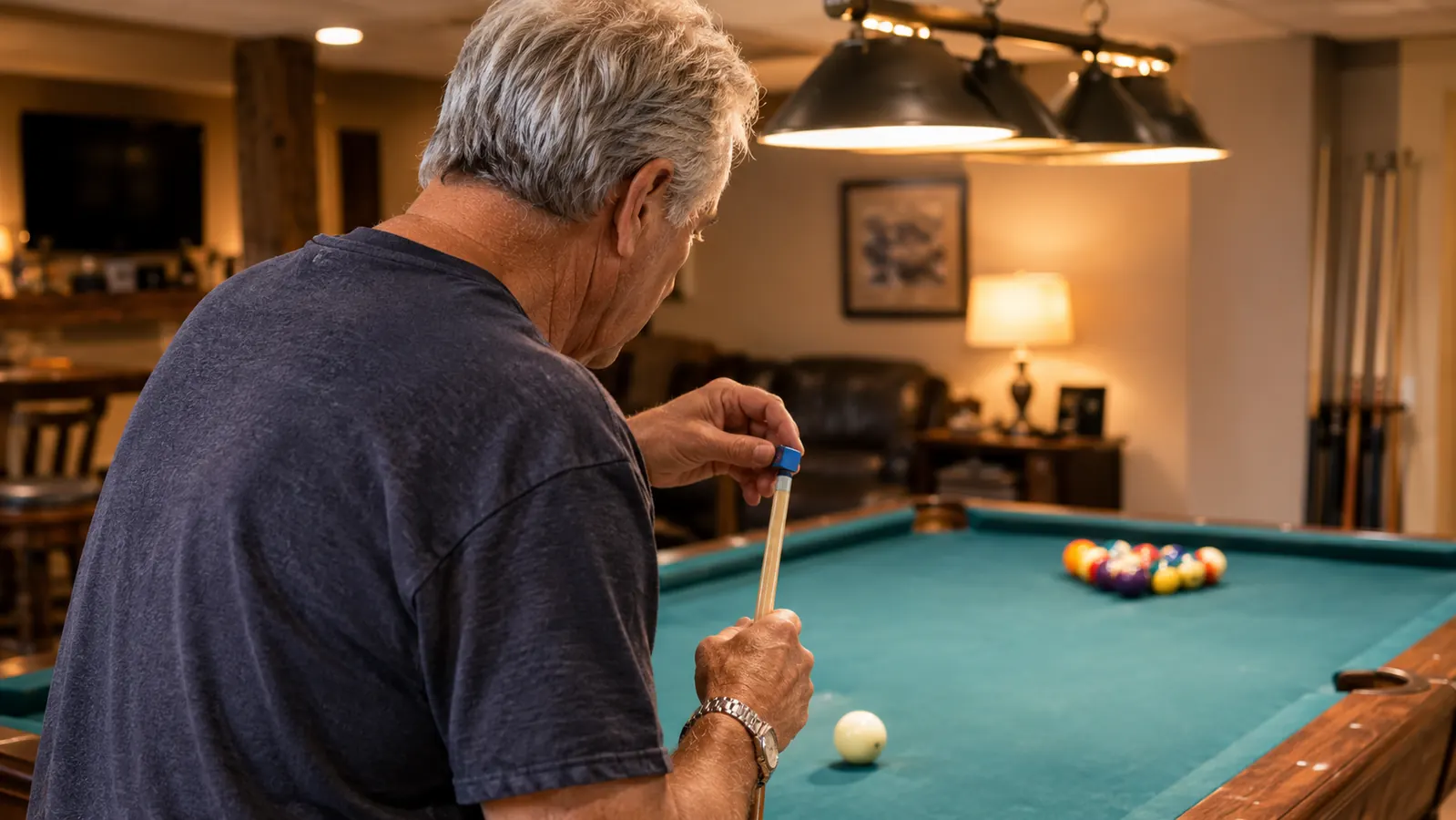
You can practice draw shots until your arm falls off and still watch the cue ball slide forward instead of spinning back. I did that for years. What I finally figured out, somewhere around my fifteenth season in the Tuesday night 8-ball league, is that the cue ball only knows what the tip tells it. Not the shaft, not the joint, not whatever the label on the butt says. A tip that has gone flat, shiny and hard is a tip that is going to skate across the ball instead of grabbing it.
That is the whole case for a tip tool, and the Cuetec Bowtie 3-in-1 is the one that lives in my case. It is a piece of metal 2.63 inches long, an inch wide and an inch tall, and it weighs 9.07 grams, so it disappears into a front pocket and I forget it is there. It carries three tools: a shaper for the dome, a scuffer for the surface, and an aerator that pierces small holes so the chalk has somewhere to sit. Nothing about it makes you a better player. It just stops your equipment from lying to you.
The cue ball does what the tip tells it to. Give it better instructions.
A shaper for the dome, a scuffer for grip and an aerator for the chalk, all in one piece of metal that weighs 9.07 grams and fits in a front pocket.
Amazon Check Today's Price on Amazon →The tip is the only part of the cue that ever touches the ball
Everything behind the tip is delivery. The shaft carries the stroke, the joint connects the shaft to the butt, and the butt is where your hand lives. But the tip is the one small patch of material that has to grab a ball and make it spin. If that patch is glazed over and the crown has flattened out, the contact area shrinks and the grip goes with it. Every draw shot and every bit of controlled side spin you think you are putting on comes down to that contact patch. It is also the part of the cue most players never touch.
A scuffed tip holds chalk instead of letting it slide off
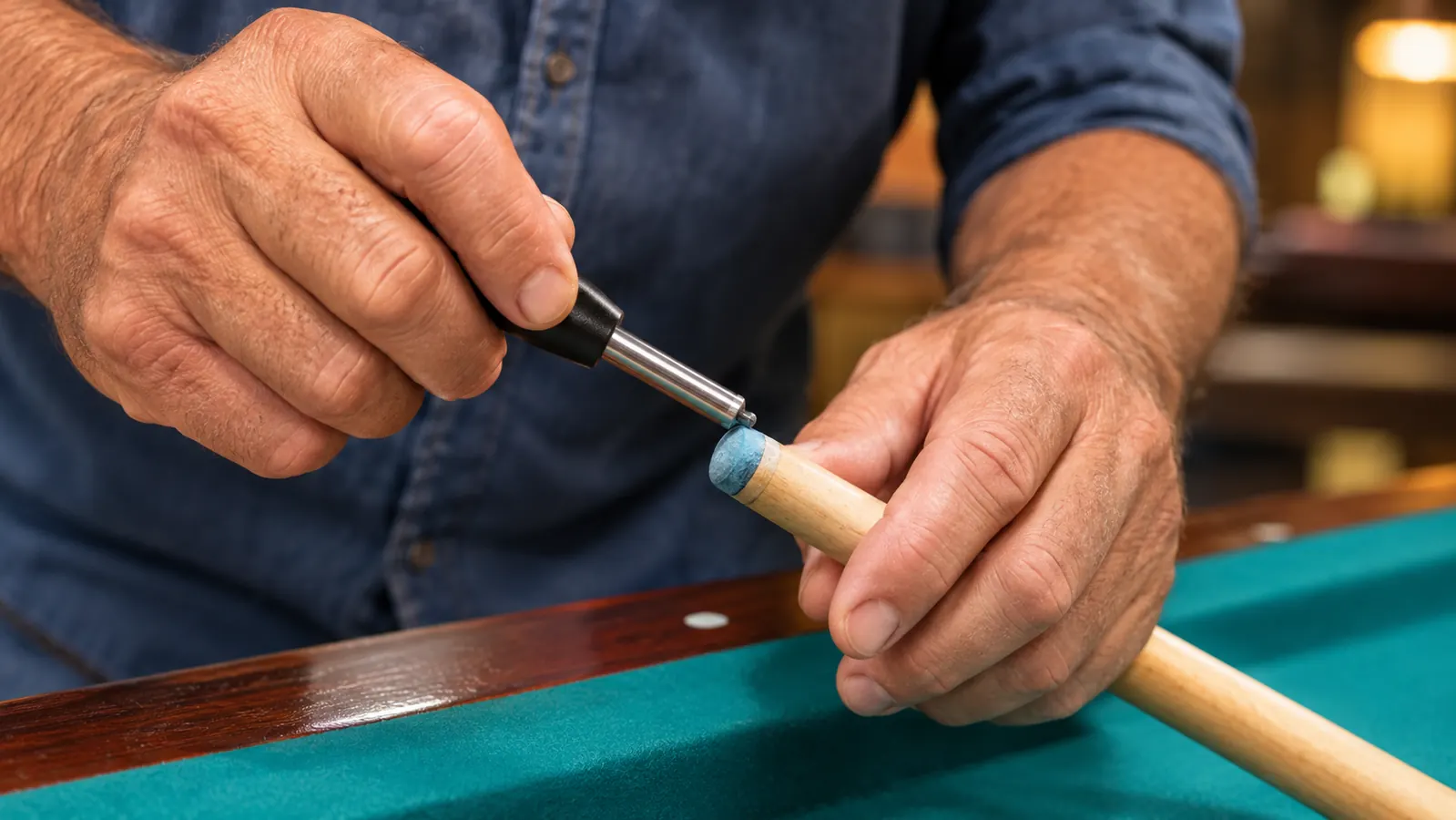
Chalk is not decoration. It is the layer that gives the tip something to grab the ball with, and it only works if the tip has a surface to hold it. Play long enough with a slick, polished tip and the chalk sits on top like dust on a shelf. One decent stroke and it is on the cloth instead of on the tip. The Cuetec tool includes a scuffer that gently roughens the surface so the chalk has something to bite into. That is the difference between a tip that grips and a tip that skids.
The shaper gives you a dome you can actually hit below center with
A flat-topped tip is a tip you cannot use properly. Get down on a draw shot and you are asking the tip to contact the ball below its equator, and a flat crown has no material there to do the work. The shaper on the Bowtie works the tip back into a comfortable dome contour, so the front of the tip meets the ball properly when you get low. Do that once a week and low contact stops feeling like a gamble.
The aerator gives the chalk somewhere to sit
Small pinholes in the tip surface are not damage, they are storage. The aerator pierces those pinholes so chalk has somewhere to settle instead of sitting loose on top and flaking off between shots. I noticed this most on break shots, where a dry tip sends chalk flying and the cue ball comes off flatter than you intended. A pierced tip holds what you put on it. Two or three turns with that side of the tool and you are done.
You stop blaming your stroke for a tip problem
For most of a season I thought my elbow was flaring out. I missed the same cut shot in practice week after week and kept adjusting my stance, my grip, my follow-through. What was actually happening is that the tip had worn into a shallow dome with a hard, shiny crown, and the ball was coming off it at a slightly different angle than I expected. One pass with the scuffer and the shot came back. A tip tool will not fix a bad stroke, but it will stop you from chasing problems that are not in your arm.
A tip that never changes shape is the closest thing to a repeatable stroke
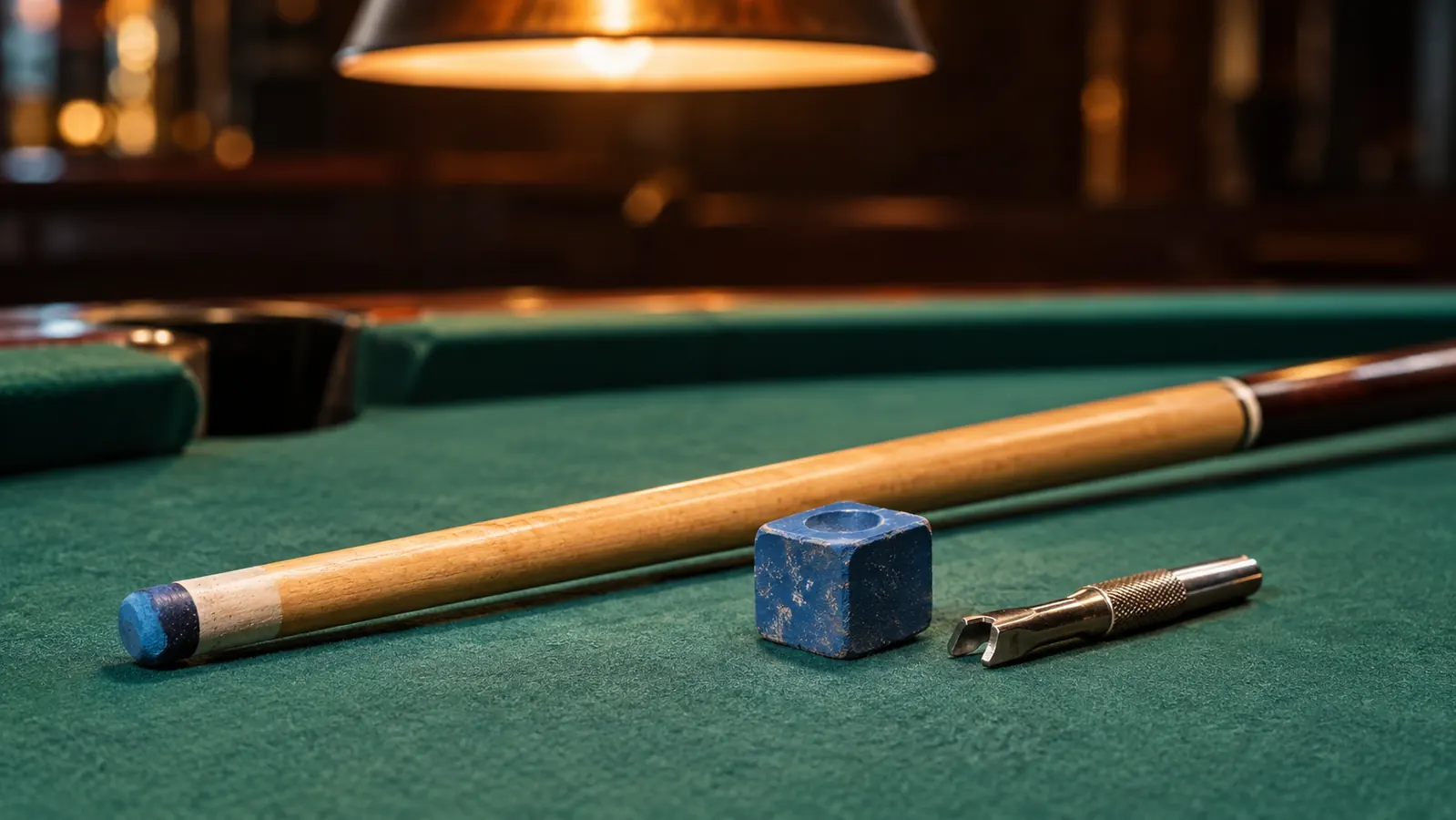
You want the cue ball to do the same thing twice. That means removing variables. Table speed changes, cloth changes, humidity changes, and none of that is yours to control. The tip is yours. If the crown stays in the same contour and the surface stays at the same roughness, then a good stroke produces the same result tonight that it produced last Tuesday. Reshape it once a week, scuff it before you play, and the tip stops being one of the things that goes wrong.
At 9.07 grams and 2.63 inches long, it actually comes with you
A tool that lives in a drawer does nothing. This one is a small piece of metal, 2.63 inches long by an inch wide by an inch tall, and it weighs 9.07 grams, which is lighter than a couple of quarters. Mine rides in my front pocket during league night and in the side pouch of my case the rest of the week. I have owned other tip tools that were bigger and better made. I never had them with me when I needed them, so it did not matter.
It pulls the ceiling up on the cue you already own
I played a two-piece cue for years that came off a rack, and for years I figured the cue was the reason for every shot that went wrong. It was not. The tip on that cue had never been shaped since the day I got it. Put a proper dome and a proper surface on the cue you already have and it will play to whatever its ceiling is. Buying another cue does not fix a tip problem. It just hands you a new tip to neglect.
Thirty seconds before the first rack beats another cue off the wall
My routine on league night is the same every week now. Pull the cue out of the case, two turns with the scuffer, one look down the tip to check the dome, chalk it. That is thirty seconds. Half a minute, and I start the night with the same tip I finished the last night with. Players around me are grabbing the house cue and wondering why they cannot get position. The difference is not talent. It is that one of us prepped.
It gives you one part of the game you can actually control
You cannot control who you draw, whether the table was leveled this century, or how the rolls go. You can control the only square centimeter of your equipment that touches the cue ball. That is a small win, and I will take it. The Cuetec Bowtie is not going to turn anyone into a better pool player. Practice does that. What it does is stop your gear from quietly working against you while you put the practice in.
What I'd Skip
A tip tool does three narrow jobs and none of them is repair. It will not fix a mushroomed tip that has bulged over the ferrule, and it will not bring back a tip worn down to the backing. If the tip is past a certain point, you need a new tip, not a shaper. It also will not fix a cracked ferrule or a shaft that has gone out of round, and no amount of scuffing makes a hard, dried-out tip soft again.
I would also skip it if you already carry all three tools separately and you like them. And I would skip the habit of overworking the tip. Two or three light turns with the scuffer before you play is plenty. Grinding at it every rack takes material off faster than you need to lose it. The tool carries a 30 day warranty against manufacturer defects, which tells you the metal holds up, but it does not cover a tip you sanded down to nothing.
The tip is the only part of the cue that ever touches the cue ball, and it is the only part most players never look at.
Reshape the dome, rough up the surface, and let the cue ball do what you asked.
The Cuetec Bowtie 3-in-1 puts a shaper, a scuffer and an aerator in one piece of metal that weighs 9.07 grams. Keep it in your pocket and you will actually use it.
Amazon Check Today's Price on Amazon →