
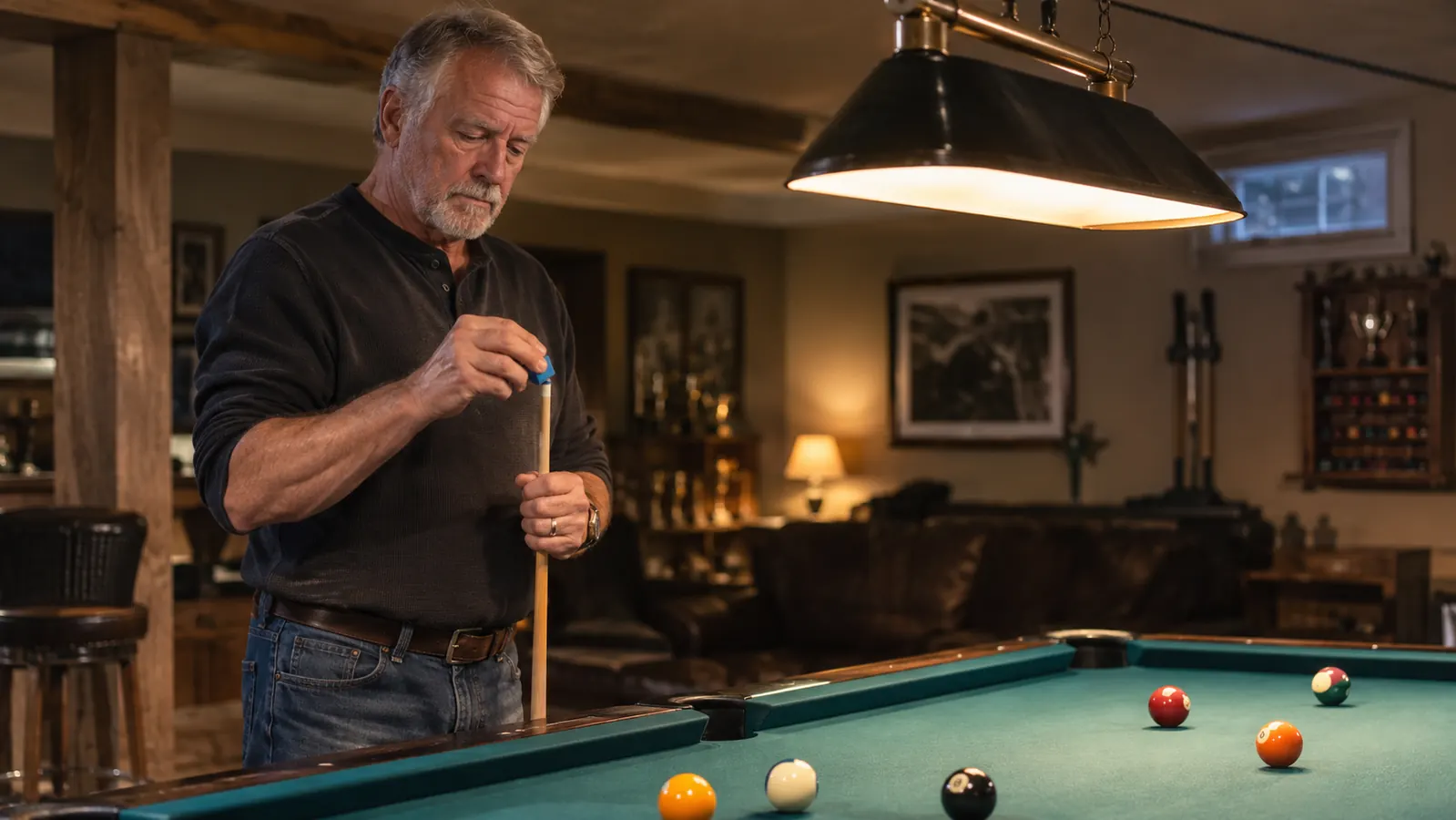
Chalk dust is not dirt. It is grit. And the moment you take a brush to the bed of a pool table, you are working that grit down into the weave where it stays, sawing at the fibers every time the brush goes back and forth. I did that for years. My 8-foot slate table has been in my finished basement for about 12 years now, and for most of them I brushed it every couple of weeks like a guy doing his chores, corner to corner, feeling pretty good about myself.
A teammate from the Tuesday night 8-ball league watched me do it once and told me to put the brush down. What he handed me instead was a spray bottle of David Hodges' Quick-Clean. I am skeptical by trade and by temperament, so I did not take his word for it. But the logic is hard to argue with. Brushing and vacuuming both push chalk down into the cloth and rough up the surface. A spray and a towel lift the grit off the table and carry it away. The label claims a table cleans in less than 60 seconds and that skipping the brush and the vacuum can extend the life of the cloth by 40 to 50 percent. A few years into doing it this way, I believe the second number.
Sixty Seconds With a Towel Beats an Hour With a Brush
David Hodges' Quick-Clean is the bottle that replaced the brush in my basement. Spray, wipe, done, and the chalk comes off the table instead of going into it. Rated 4.4 from more than 1,500 reviews.
Amazon Check Today's Price on Amazon →Step 1: Clear the Table and Read the Cloth Before You Touch It
Balls off. Rack off. Chalk off the rail, and it does not go back on the rail when you are finished. Wash your hands before you start. The oil on your hands is half of what turns a cloth gray over time, and there is no sense wiping down a table with dirty hands and calling it clean.
Then turn the lights up and sight down the bed at a low angle. You are looking for three different things. Loose chalk sitting on the surface, chalk that has already been pushed into the weave, and damage that cleaning will not touch. A tear at the pocket mouth, a seam starting to lift, a burn mark from somebody setting a cigarette on the rail in another decade. If the cloth is torn, stop. A spray will not fix a tear, and all you will do is make the tear damp.
Know what cloth you are standing over, too. Worsted cloth is tight and smooth. Woolen cloth has a nap and holds more dust. The label on this spray says it is safe on all types and grades of pool table cloth, and I have run it over two different cloths on this same table without an issue.
Step 2: Get the Loose Grit Off the Rails and Pockets First
The rails are where the chalk lives. A guy chalks his cue and sets it down on the rail, or chalks it right over the table, and the dust settles exactly where his bridge hand goes all night. Wipe the rail tops with a clean, dry microfiber towel before you go anywhere near the bed, and wipe toward the pockets, not toward the playing surface.
Do the same at the pocket mouths and the little shelf inside the corner pockets. Tap the grit loose, take it out with the towel, and get it off the table. What you are avoiding is the move everybody makes: one long sweep across the whole bed that drags every bit of dust from the rails to the middle of the table, which is the one place you cannot afford to leave it. Do not vacuum the bed, either. The maker's position is that vacuuming wears cloth out, and once you watch a vacuum head grab a loose cloth and pull it, you stop arguing about it.
If you are nervous the first time, do a rail before you trust the whole bed to a towel. The towel tells you what was on the table. Mine comes up gray in the middle and almost clean near the rails, which tells me exactly where the play happens and where I need to spend the extra time.
Step 3: Mist One Section and Wipe It, Then Move On
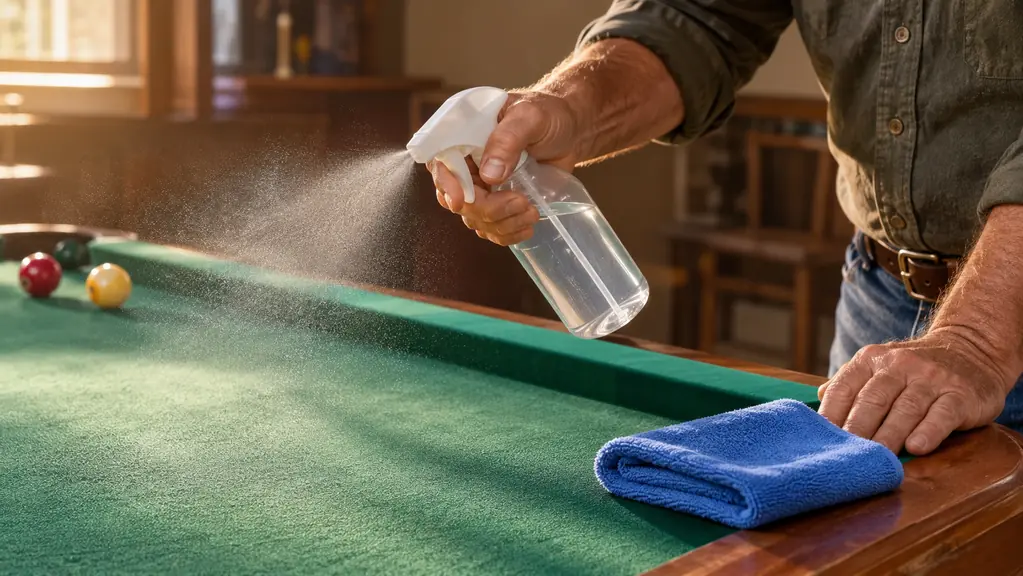
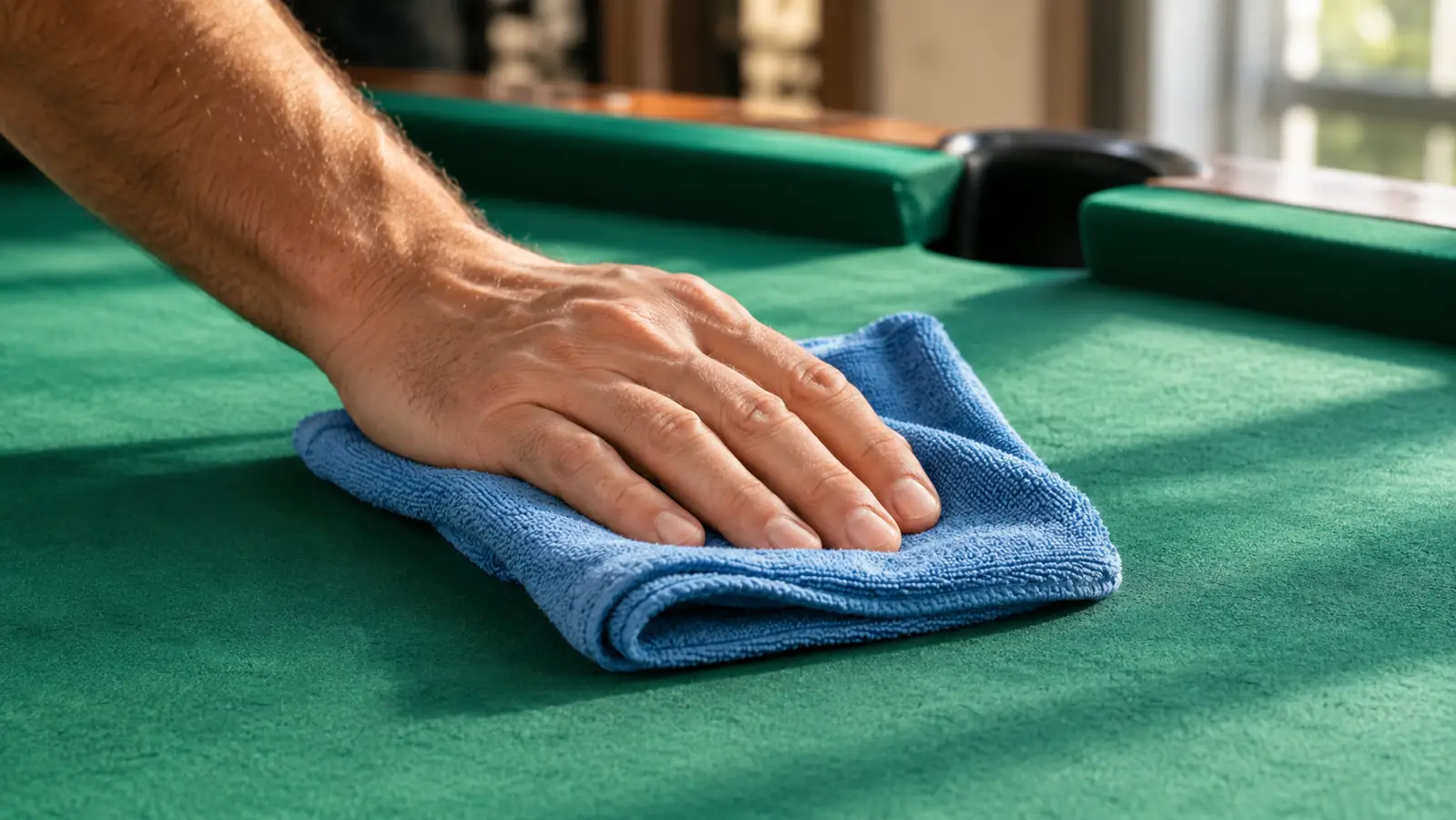
Spray the cloth, not the pile of dust. A light mist over an area about two feet square, then wipe with a folded microfiber towel using flat, even strokes. Do not scrub. Scrubbing is brushing with a towel, and you have already decided to stop doing that. The point is to lift the grit onto the towel and then take the towel away from the table, so fold it, wipe, flip to a clean side, wipe, refold. By the time you have used all eight sides of a folded towel, that towel is finished for the day and goes in the wash.
Work down the table and overlap your sections a little so you do not leave stripes in the cloth. The whole bed goes faster than three games of eight ball. The manufacturer says under 60 seconds. I have never stood there with a stopwatch, but I have cleaned this table in the time it took Mike to run upstairs and come back with two glasses of water, and he does not hurry.
This is also the part that surprises people with older cloth. The label claims it brings older cloth back toward its original color and playing speed, and in my experience the color part is real. A bed that read gray-brown in the middle comes back closer to what it looked like the day it went on. It is a cleaning, not a re-covering. But it is the kind of cleaning that lets you put off pricing new cloth for another season.
Step 4: Do the Rails, the Cushion Tops, and Along the Nose
Most guys clean the bed and forget that the rail tops and the cushion tops are cloth as well, and they collect the same chalk all night. Mist the towel lightly rather than the rail itself, wipe the rail tops, then run a clean dry corner along the base of the cushion where the dust piles up against the rubber.
Be careful around the feather strips and around the seams at the pockets, where the cloth is fastened down. That is where moisture does its damage, because water wicks under the cloth and swells the wood or works at the adhesive. Light mist on the towel, never a wet towel on a seam, and keep the spray away from the pocket liners and the leather.
The cushion noses, the part the balls actually bounce off, I mostly leave alone. A dry pass with a clean towel is plenty. They take enough of a beating without me rubbing at them.
Step 5: Let It Dry, Then Change Whatever Put the Grit There
Give it a couple of minutes. The cloth should feel dry to the back of your hand before anybody racks a ball. Playing on damp cloth picks up lint, leaves streaks, and puts moisture where you least want it. If you keep a cover, this is the moment it goes back on, not tomorrow morning after the table has sat open all night with the basement window cracked.
Then look at the habits that made the mess. Chalk stays in the pocket, not on the rail. Hands get washed before practice. No drinks on the rail, no exceptions, and I say that as a man with a ring in his own rail from a glass of iced tea. The table gets covered when it is not in use. The basement stays dry, because humidity gets into cloth and stays there in a way chalk dust does not.
How often? On a table that gets played three or four nights a week, I do a full pass about once a month and a quick wipe of the rails and pockets more often than that. When the league team comes over, it gets done the next morning. It is a five-minute job, and the whole value of a five-minute job is that you will actually do it.
The brush never took anything off that table. It just moved the chalk from where I could see it to where I could not.
What Not to Use on Pool Cloth
Skip the brush that came with the table, and skip the vacuum. Those two are the default and they are also the reason cloth wears out in the middle of the bed long before the rails ever go. Anything with bristles is working the grit in deeper, and a vacuum head is grabbing at fibers that are already loose.
No soaking. This is a spray and a wipe, and a misted towel is the whole technique. Water alone will not lift chalk, and too much of it leaves a tide line and a damp patch that takes hours to dry under a slate bed. Household cleaners are worse. Anything with bleach or a strong solvent has no business near cloth, which is why it is worth noting this spray is chlorine free.
I would also stay away from upholstery shampoo, laundry detergent, and anything foamy. They leave a residue behind that grabs dust faster than bare cloth did, and then you are cleaning twice as often to keep up with a problem you created. If a spill happens, blot it with a clean dry towel first and deal with the spot on its own. Do not flood the area.
One more that gets recommended on forums: rubbing alcohol. It takes up chalk, and it also dries out the fibers and leaves the cloth feeling stiff and slick. I tried it on an old bed years ago to lift a mark and that spot stayed slick for a month. Not worth the trouble when a spray made for cloth does the job without the side effect.
What Else Helps
A cover is the cheapest thing you can do for a table and the one most often skipped. Dust in a finished basement is not the same as dust in a garage, but it is still dust, and it settles on a bed that sits open for a week. The cover goes on every night, not just when the table is going to sit for a month.
Chalk matters more than people think. Cheap chalk crumbles and leaves more of itself on the cloth. Keeping the cube in your pocket instead of on the rail does more for a table than any single cleaning step. And on new cloth, the label claims this spray eliminates the slide that makes a fresh bed play fast and grabby. I have felt that change on a new bed. It settles down a notch after a pass, closer to how it will play in a month.
Wash your microfiber towels on their own, and never with fabric softener. Softener coats the fiber, and a coated towel just pushes dust around the table instead of picking it up. Keep two or three on hand so you are never tempted to reuse a dirty one because the laundry has not happened yet.
Last thing, and it is boring. Rotate where you play from. Most players break from the same end of the table for years, and the cloth wears where the cue ball gets slammed from. Breaking from the other end once in a while spreads the wear. So does practicing your draw shots from a few different spots instead of the same one. Cloth does not fail evenly. It fails where you keep hitting it.
The Cloth You Save Is the Cloth You Do Not Have to Buy
A bottle of David Hodges' Quick-Clean, a folded microfiber towel, and five minutes once a month. That is the whole system I run on an 8-foot table that is 12 years old and still playing on cloth I did not have to replace this year.
Amazon Check Today's Price on Amazon →