Here is the part of tip care nobody prints on the package. Almost every tip tool I have owned came free in a drawer with something else, and almost every one of them either chewed the tip up or did nothing at all. I have a coffee can in the basement with a decade of them in it. The Cuetec Bowtie 3-in-1 is the one that stayed in my case, and it stayed because it does three specific jobs and then stops. It is a small metal tool, about two and a half inches long, and it handles shaping, scuffing and aerating a cue tip.
I am not going to tell you it made me a better pool player. It did not. What it did was remove one specific kind of miss, the one where you strike the ball clean and the cue ball still does something stupid because the tip had glazed over and grabbed a fraction late. That is the honest version. Twenty years in a Tuesday night 8-ball league on Long Island, an 8-foot slate table in my basement that I bought used about twelve years ago, and the difference between a tip that holds chalk and one that does not is the difference between trusting your stroke and steering it.
What pushed me to buy one was a skid in a league match that cost me a game I should have won. The tip looked fine. It felt fine when I chalked it. Then the cue ball jumped a quarter inch off line on a shot I had made a thousand times, and I stood there like a man who had been handed the wrong groceries. The tip had glazed and I had not noticed, because nobody teaches you what to notice.
The Quick Verdict
Three jobs, one small metal tool, no gimmicks, and a routine that takes under a minute. If you already have a shaper you trust, you are not missing much. If you are still playing whatever tip the cue came with, this ends the guessing.
Amazon Check Today's Price →The one minute fix for a tip that stopped grabbing
Shapes the dome, roughs the surface, and pokes the pinholes that hold chalk. Small enough to live in a case pocket and be forgotten until Tuesday.
Amazon Check Today's Price on Amazon →The Tip Problem Nobody Explains at the Pool Hall
A cue tip is a piece of pressed leather on the end of a stick with one job: hold chalk so the cue grabs the ball instead of sliding past it. When it is new and rough, it does that well. Over a few months of league nights it compresses, flattens and glazes, and chalk stops sticking to it. You do not get a dramatic failure. You get a draw shot that used to come back two feet and now comes back eight inches, so you hit harder to make up for it, and hitting harder is how you start missing.
Nobody teaches this at the hall. You learn it by watching a guy in his seventies pull a folded piece of sandpaper out of his wallet. Sandpaper works, up to a point. The problem is that sandpaper is flat and a tip is supposed to be domed, and you can sand a dome off a tip in about thirty seconds without meaning to. The other problem is that sandpaper loads up with leather dust and stops cutting, so you press harder, and now you are taking off more than you wanted.
I tried the sandpaper route for two full seasons before I gave up on it. I cut a square about two inches on a side, kept it folded in my case, and used it every couple of weeks. By the third month the tip on my old cue had a slight flat spot on one side where I had leaned on it, and I could feel it on every draw shot I hit from that angle. I did not understand what I had done until a guy at the hall looked at it and told me I had sanded a shoulder into it. That was the end of my sandpaper career.
A shaper does the same job with a fixed contour, so the tip comes out the same every time instead of however hard you leaned on it. That is the whole case for carrying a tool instead of a scrap of paper, and it is a good case. It also explains why the tool in my case is a Cuetec and not the fourth square of sandpaper I have bought at a hardware store in the last five years.
Here is how you know which kind of tip you are playing with. Chalk a glazed tip and look at it. The chalk sits in a thin dusty film and comes off on your finger. Chalk a tip that has just been scuffed and the chalk presses into the leather and stays there. That difference is the whole game. A tip that will not hold chalk will not hold the cue ball, and you can feel it in your hand before you ever get down on a shot.
How I've Actually Used It
Two years now, near enough. It lives in the small pocket of my case and comes out before league on Tuesday, sometimes between racks if the tip feels slick, and at home on the 8-foot table in the basement on weekends when I am practicing and something feels off. I have never had to think about where it is, which is its own kind of endorsement.
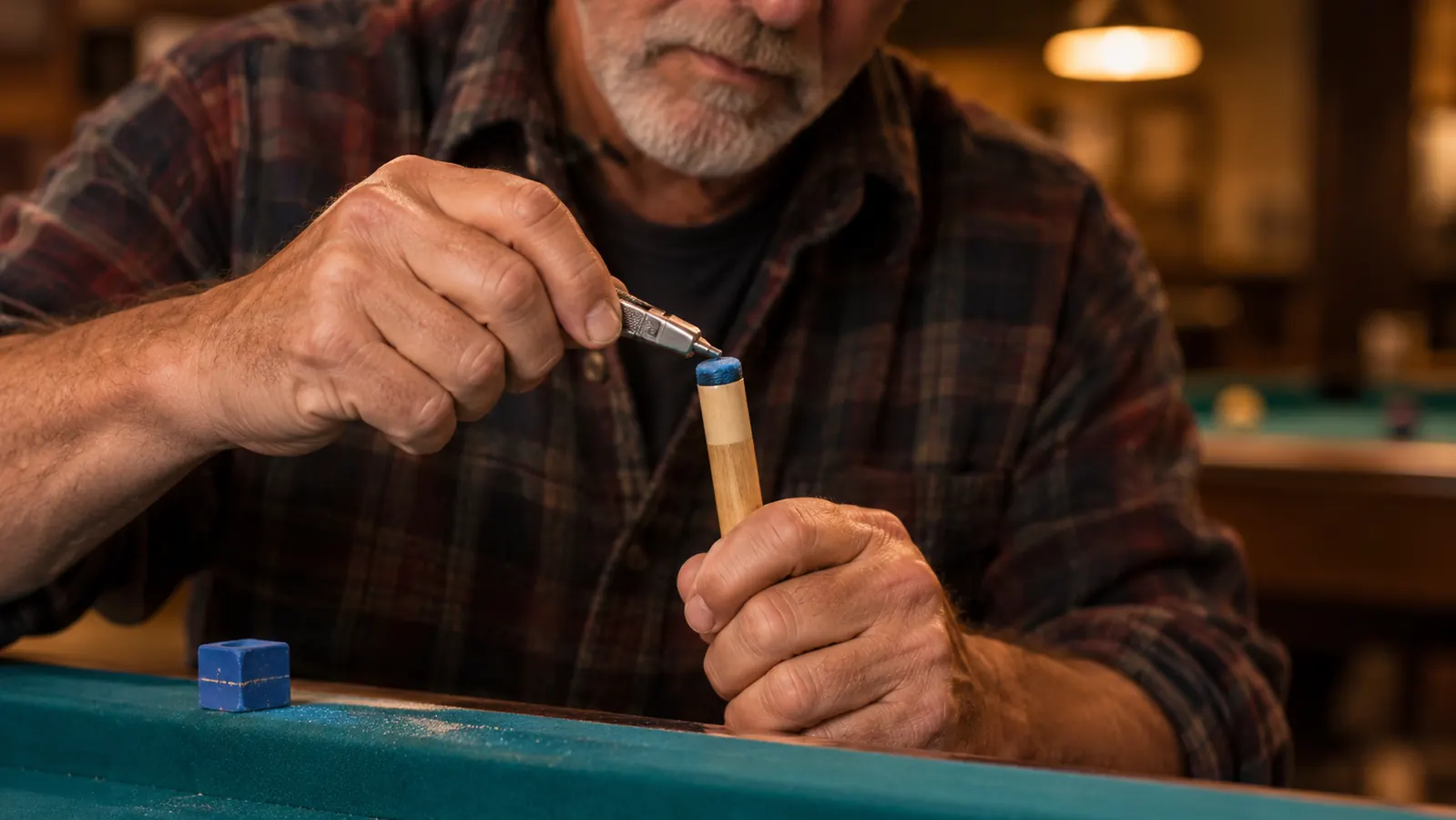
The routine is short. Two or three light turns with the shaper to put the dome back, a few passes with the scuffer to open the surface, a press or two with the aerator, then chalk. Under a minute, start to finish. That minute is the difference between a tip that plays in week twelve the way it played in week one and a tip that slowly changes under you while you blame your stroke.
The Tuesday I keep thinking of was in February, cold enough that the front door of the hall stuck when I pushed it. I had come in from the truck with hands that were not fully warm, and cold hands plus a glazed tip is a bad pair. I scuffed the tip twice before the first rack, chalked it, and played the whole night without once thinking about the cue. Two years earlier I would have blamed the table, the cue ball, or the fella racking. The tool did not make me play well. It took one excuse off the table.
The night I noticed it working was unremarkable, which is the point. Middle of a league match, a cut shot into the side pocket, and the cue ball came off the tip the way it had in practice. No grab, no skid, no wondering. I did not think about the tip again for the rest of the night. That is what good maintenance feels like from the inside: nothing.
I want to be clear about how little skill this takes. I am a retired electrician, not a cue maker. There is nothing to learn here beyond not bearing down like you are drilling a hole in a joist. Light pressure, a few turns, done. The tool does the shaping. You just have to stop yourself from overdoing it.
A fresh tip does not give you a better stroke. It gives you the stroke you already have, delivered the same way every Tuesday.
The Three Jobs, One at a Time
The shaper is the one that matters most and the one most people get wrong. It puts a dome back on a tip that has flattened. Not a point, not a flat top, a dome, the gentle curve that lets the tip meet the ball at whatever angle your stroke produces. A flat tip hits the cue ball on a corner of the tip instead of the middle of it, and that corner does not hold chalk and does not grab. Because the Cuetec contour is fixed, you turn it and it cuts the tip to that shape and then stops cutting. You would have to sit there grinding for minutes to do damage, and nobody does that.
I check the dome with my thumbnail before I chalk, and that habit came from doing it wrong first. Lay the tip flat against the pad of your thumb and look at the gap. A good dome touches in the middle and shows a thin even crescent of space on both sides. If the gap is wide on the left and closed on the right, the tip is off, and a few more turns will not save it unless you keep the tool square to the tip and turn it evenly. I check once a week now. I used to check every night, which was the over-shaping problem in a different jacket.
The scuffer is the one you will reach for most. Every few racks the surface of a tip polishes shiny, and chalk sits on top of it instead of pressing in. The scuffer roughs that surface back up. It takes about four seconds and it is the simplest consistency you will ever get out of a piece of gear. In a league match, when you feel the tip slide instead of bite, that is the fix, and you can do it while your opponent is chalking.
The aerator is the step people skip, and I understand why. Poking pinholes in a tip sounds like something a bored guy does at the counter. What it actually does is give the chalk somewhere to go. Small perforations let chalk press into the tip instead of sitting on the surface waiting to fall off. I notice it most on the break, where a slick tip throws chalk and an aerated one holds what you put on it.
All of it is in one metal body about two and a half inches long that weighs about nine grams. It has been dropped on a concrete floor, forgotten in a jacket pocket, and carted to league for two years, and nothing on it has loosened or dulled enough that I noticed. There is a 30 day warranty against manufacturer defects, which tells you what the maker thinks of the odds of that happening.
It also comes with a small slip of instructions. That sounds like nothing until you remember that half the people who buy this have never used an aerator and would not know what to do with one. The paper explains the three steps. Read it once. You will not need it again.
The one thing I would change is the size. It is small enough that losing it is a real possibility, and I have come close twice. A hole for a keyring would have solved that. Instead I keep it in the same pocket every single time, which works but requires me to be the kind of person who keeps things in the same pocket, and I am only sort of that person.
What I Liked
- Three functions that cover the whole tip routine in under a minute
- The fixed contour takes the guesswork out, so the dome comes out the same every time
- Small and light enough to live in a case pocket and never be noticed
- Metal body has held up to two years of Tuesday nights without loosening or dulling
- Simple enough that a first-timer can read the slip of paper once and be done
Where It Falls Short
- The aerator is the step most people skip, and it is the one that needs the most explaining
- Instructions are a small slip of paper, so a beginner may still need to look up what a dome should feel like
- It cannot rescue a tip that is already worn thin or flared out over the ferrule
- Nothing about it is adjustable, which is the point but also the limit
What It Does Not Do
First, it will not rescue a tip that is already finished. A tip has a lifespan. When it is worn down thin, or when the edge has flared out over the ferrule, no tool in your case brings it back. That is a repair bench job and it takes a person with a lathe. The Bowtie is maintenance, not restoration, and the sooner you accept that the less disappointed you will be.
I found that out with the tip that came before this one. It had been on the cue a bit over two years, which for a fella who shoots twice a week is a lot of leather, and the edge had started to mushroom out over the ferrule. I shaped it, scuffed it, aerated it, and it still played like a wet sponge. The repair guy took one look, put the shaft on the lathe, and charged me for a new tip and a trim of the ferrule. He told me I should have brought it in six months earlier. He was right, and I knew it before he finished the sentence.
Second, it will not fix a crooked stroke. If you are hitting the cue ball off center, a fresh tip means your miss is more precise. I mention it because you can find people online claiming a tool added three balls of draw to their game. What a good tip gives you is the draw you already had, delivered the same way every time. The extra comes from drills, and drills are boring, which is why nobody sells them.
Third, it does not tell you when to use it. No gauge, no indicator, nothing. You develop a feel for a glazed tip over a season or two, and until you do you will either over-shape it or ignore it. I over-shaped. My first tip after buying this came down further than it needed to because I was doing the routine every single night whether it needed it or not. Shape rarely, scuff often, aerate when the chalk stops sticking. That is the whole schedule, and it took me a few months to settle into it.
The Parts That Bug Me
Two small things. The aerator is easy to forget, and when you forget it the tool feels like it is doing two thirds of a job. That is on me, not on the tool, but a reminder would be welcome. There is no such thing as a cue maintenance tool that nags you, and this one does not try to be.
And the shaper removes material every time you use it. Any shaper does. Habit is the enemy here. If you touch it up after every single rack you will shorten the life of a tip that had plenty left. Once a week, plus a scuff whenever the surface goes slick, is what has worked for me. The tool is not expensive, but a tip replacement is a trip to the repair man, and I would rather not make that trip because I was bored on a Tuesday.
Who This Is For
If you play league or practice at home on a table you own, and you have ever walked away from a shot that felt clean and did not do what you wanted, this belongs in your case. It also makes sense for a newer player, because it teaches the routine rather than just fixing the symptom. I handed mine to my son Mike to use on his own cue and he came back with it, which is more than I can say for most of what I lend out. If you are the guy at the hall who is always asking to borrow a shaper, this ends that conversation permanently.
Who Should Skip It
Skip it if you already own a shaper you trust and keep a square of sandpaper in your case. The Bowtie is not so much better than a working system that you need to replace one, and I would not want you to think otherwise. Skip it if your cue lives at the hall and belongs to the hall, because the tip is not yours to maintain. And skip it if you are hoping a piece of gear will do your practicing for you. Nothing in a case does that, and this tool is honest enough not to pretend otherwise.
Stop steering your stroke around a slick tip
Shapes the dome, opens the surface, and holds the chalk. One small tool, one minute before league, every Tuesday.
Amazon See the Cuetec Bowtie on Amazon →