
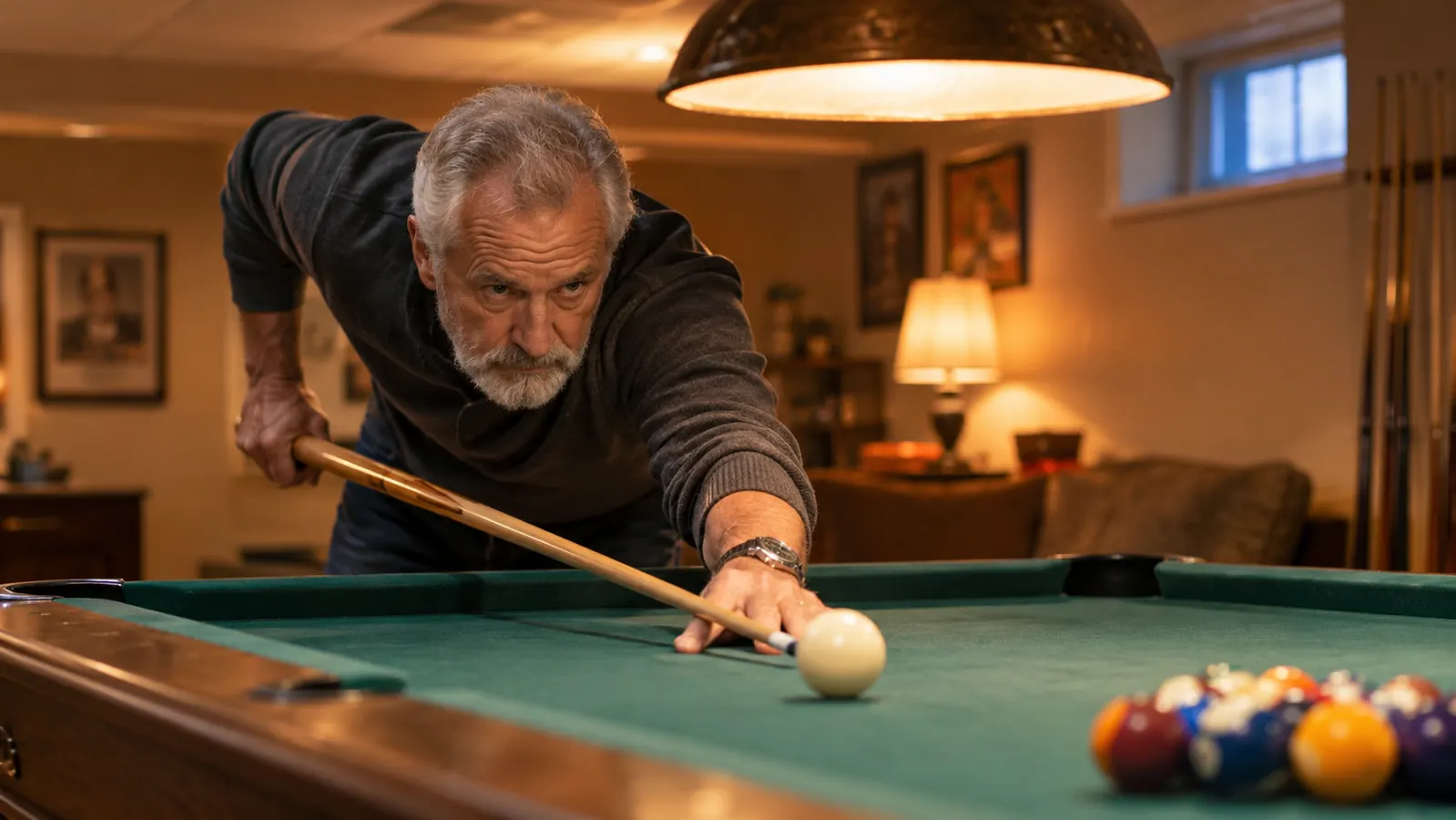
Nine out of ten miscues I see in league play have nothing to do with a guy's stroke. He gets down on the ball, feathers it a few times, pulls the trigger, and the cue ball hops or the shot dies short. Then he stands up and blames his aim. It was not his aim. It was the tip, and the tip was either slick and bare or packed so thick with chalk that the leather had gone hard underneath. Chalking is the simplest fix in the game, and most players do it on autopilot, if they do it at all.
I play Tuesday nights in an 8-ball league and I have an 8-foot slate table in my finished basement that I bought used about twelve years ago. I practice on it most weekends, usually with my son Mike, and I have watched a lot of chalk go onto a lot of tips over the years. For the past couple of seasons the box sitting on my rail has been Imperial Master cue chalk, twelve cubes in a protective box. I keep buying it for boring reasons: it goes on smooth and even, it does not cake or flake, and one cube lasts a long time. Here is how I actually use it, step by step, including the parts most players get wrong.
The box that never leaves my rail
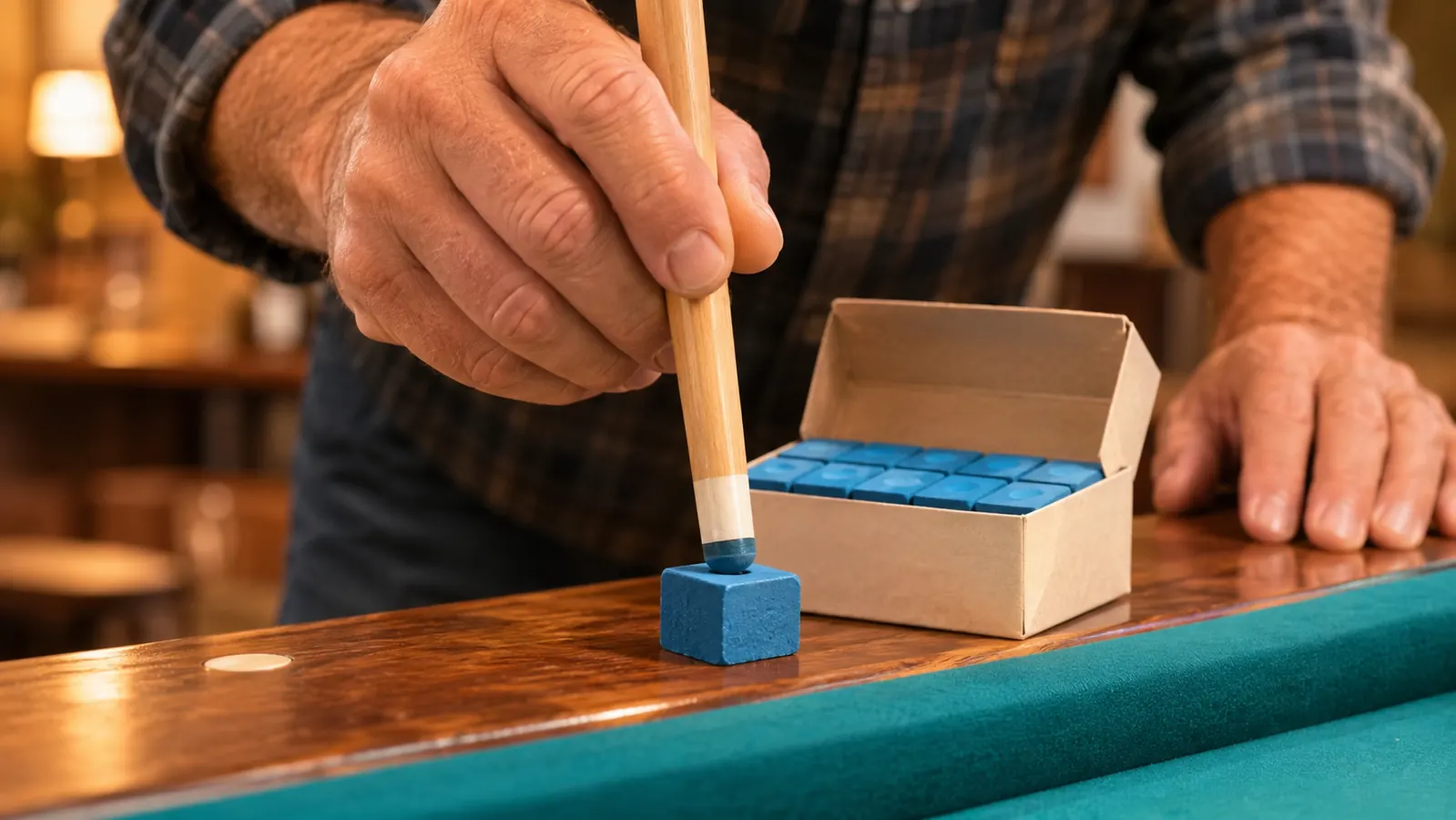
Twelve cubes of Imperial Master chalk in a protective box. A smooth, even coating that will not cake or flake. This is the same box I chalk from every Tuesday night.
Amazon Check Today's Price on Amazon →First, What Chalk Is Actually Doing
Chalk is not decoration for the tip. It raises friction between the leather and the cue ball so the tip grabs instead of sliding. A bare tip on a center-ball shot will usually get away with it. Put the same bare tip under the cue ball for a draw shot, or out on the edge for a little english, and the tip skids off. What you get is a miscue that sounds like a click and feels like a shank through your whole arm.
The second thing chalk does, when you use the right amount, is nothing at all. It should be invisible in the shot. A thin, even coat on a tip in decent condition is all the friction you need. Pile it on and you get a fuzzy ball that sheds dust onto the cloth every time you hit the cue ball. Worse, you stop noticing that the tip underneath has gone hard and shiny, because the chalk is covering it up.
Step 1: Put the cube down and bring the cue to it
Nearly every player I know holds the chalk in one hand and jabs the cue at it in the air. That is how a cube gets a crater drilled into the middle of it, and it is why half the cubes on a pool hall rail are hollowed out and useless by the time anybody throws them away.
Before I switched to setting the cube down, I was that guy boring a hole in the middle of it. I still have one in the bottom of my case, hollowed out to about the size of a dime, and there is no way to get a flat coat out of a cube shaped like a bowl. A cube used the right way wears down evenly across the whole face, and mine now go until they are too thin to hold between two fingers.
Set the cube flat on the rail, hold the cue a few inches above the joint, and lower the tip down into the chalk. The cube stays put. The cue does the moving. You get an even coat because the face of the cube stays flat against the tip, and the cube lasts because the wear spreads across the surface instead of boring one deep hole.
I started doing it this way out of laziness more than technique. The box sits on the rail, the rail is right there, and it was easier than holding the chalk up in the air. Turns out it is also the correct way to do it, and it is the single change that made the biggest difference in how the tip on my player holds up over a long night.
Step 2: Twist, do not stab
Light pressure and a quarter turn. Press the tip into the chalk, rotate the cue a quarter turn, press again, and repeat four to six times until the whole face has a coat on it. You are dusting the leather, not grinding it into powder.
Stabbing does two bad things. It cracks the tip, especially a soft one, and it puts a puff of loose chalk in the air and down onto the table every single time. The Imperial cubes are packed tight and fibrous, so a light twist picks up plenty. I have never needed to lean on it to get a full coat.
The cubes are dense enough that a light twist takes a full coat instead of crumbling a corner off. I have pulled a cube out of my case after a whole winter in the basement and the edges were still square. That matters more than it sounds like. Soft chalk that breaks apart under light pressure means you are chalking twice as often, and half of what you break loose ends up on the cloth.
There is also a grip detail here that nobody mentions. Hold the cue loosely by the wrap or the butt end when you chalk, not up near the tip. A hand up by the ferrule means oil from your fingers ends up on the leather, and oil is the exact opposite of what you want on a tip that needs to grip a cue ball.
Step 3: Cover the edge, not just the center
Stand a cue tip up and look straight at it. Most of them have a bald ring around the rim where the chalk never reached, because the player only ever pressed the middle of the tip into the cube. That ring is exactly where the cue ball contacts the leather on a draw shot or a cut with english on it.
Tilt the cue slightly and work the chalk around the shoulder of the tip, all the way around. Not so far down that you are chalking the ferrule, just enough that the whole leather dome has a coat on it. It costs you one extra second at the table. It is the difference between a miscue and a shot that comes back off the rail the way you planned it.
The shot that taught me this was a long draw I used to practice over and over on my basement table. I would hit it clean and the cue ball would just float forward, no spin, no nothing. I blamed my stroke for weeks. The tip was bare around the rim, and I was hitting the bottom edge of the cue ball with the one part of the leather that had never seen chalk.
Step 4: Know when to stop
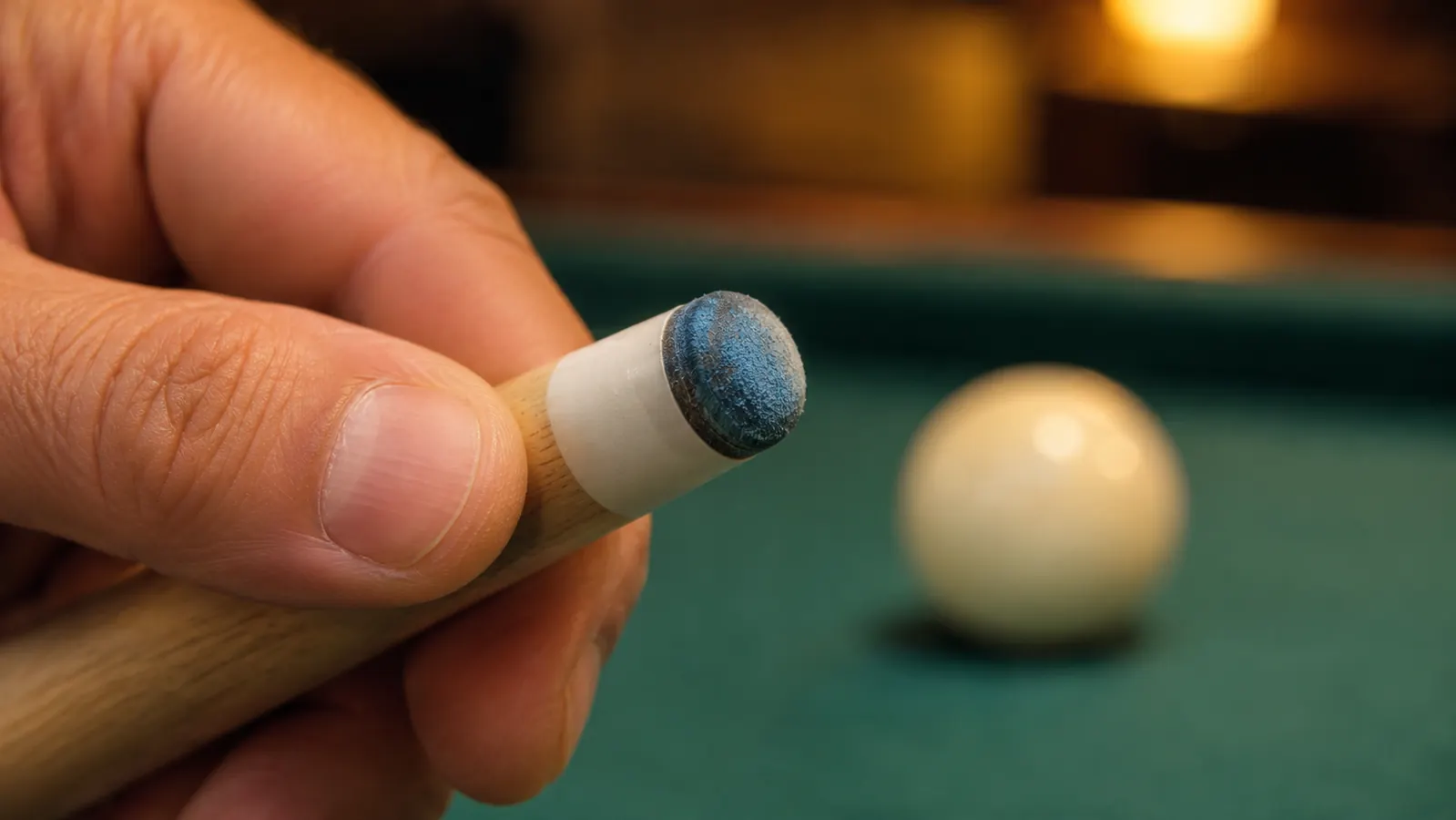
A properly chalked tip still shows the texture of the leather. You should see a light, even coat, not a fuzzy ball. If I can no longer see the tip, I have overdone it, and the excess is going to fall on the cloth the next time I hit the cue ball.
Over-chalking also hides a problem. A tip that has gone hard and glazed will take chalk on the surface but will not grab the ball. Players pile more chalk on because shots keep slipping, and the pile makes it look like they are doing maintenance. The tip is the problem, and no amount of chalk fixes a tip that has gone slick.
My rule is simple. If I have to chalk before every single shot to keep the tip grabbing, I stop chalking and I take a scuffer to the tip instead. That fixes it. Adding more chalk never has, and I have wasted a fair number of league nights proving it.
I check the tip about once a month now, usually on a Sunday afternoon when I am already brushing the table. Hold it under the lamp and look at the leather. If it has gone shiny and the chalk sits on top like dust on a windowsill instead of working into the nap, it is scuffer time. Ten seconds of looking has saved me more shots than any new cue ever did.
Step 5: Chalk on a rhythm and keep the cubes in the box
Chalk between shots, but keep it to a couple of quick turns. Some guys make a production of it. Chalk, blow on the tip, wipe the tip on their shirt, chalk again. That is a routine, not maintenance, and it slows the whole table down while everybody else waits.
Where it actually matters: before the break, after any hard draw or jump, and any time you have hit the cue ball off center. Those are the shots that thin the coat out. A quick touch-up in between keeps the tip consistent, and consistency is the whole point of any of this. Mike and I both chalk the same way now, mostly because he got tired of listening to me explain it.
The box the Imperial cubes come in is not packaging to throw away. Twelve loose cubes rattling around in a case pick up grit and dust, and grit on a tip is worse than no chalk at all. I keep the box on the rail, pull one cube out, and put it back when I am done. I am maybe four cubes into a box after a couple of seasons of league nights and weekend practice, so a box goes a long way.
What Else Helps
Chalk only solves the tip-to-ball problem. A few other things matter just as much, and none of them take any real effort.
Tip condition comes first. A glazed tip, one that has gone shiny and hard, will not hold chalk no matter how carefully you apply it. A scuffer or a piece of coarse sandpaper, used lightly, puts the nap back on the leather. Do it over a trash can, not over the table. Tip shape matters too. A tip that has mushroomed out flat contacts the ball differently than one with a nice curve, and a flat tip is more likely to miscue off center.
Second, keep the cloth clean. Chalk dust that falls on the table works into the cloth and stays there. If you brush your table and the brush comes up thick with chalk, the problem is not the brush. Chalking over the floor instead of over the table, and keeping the cubes in the box, cuts most of that down.
Third, conditions. My basement is dry in January and damp in July, and the chalk behaves differently in each. The table sits a few feet from the furnace, so January is the dry end of the year down there and July is the opposite. On a humid night the cubes pick up moisture and go on thicker, so I use less and take two turns instead of five. In the winter the chalk is drier and takes a couple more turns to build the same coat. I keep the box closed when I am not using it, mostly for that reason. You adjust without thinking about it after a while.
Last thing, and this is the part nobody wants to hear. None of it makes you a better player. A clean, well-chalked tip stops the equipment from costing you shots. It does not add a stroke, it does not teach you to leave the cue ball on the right side of the next ball, and it does not make a cut you cannot aim. It removes one excuse. That is worth doing, and it is also all it does.
If I have to chalk before every single shot to keep the tip grabbing, the chalk is fine and the tip is done.
The one piece of gear I stopped thinking about
Imperial Master cue chalk, twelve cubes in a protective box. A smooth coating that will not cake or flake, and enough cubes to last a couple of seasons of Tuesday nights.
Amazon Check Today's Price on Amazon →